Zero-click AI search for B2B SaaS: how to survive the 60% organic click loss and win direct LLM recommendations
Discover how zero-click AI search is eroding B2B SaaS website traffic by over 60%. Learn how to pivot from click-capture SEO to recommendation seeding with Pulse.
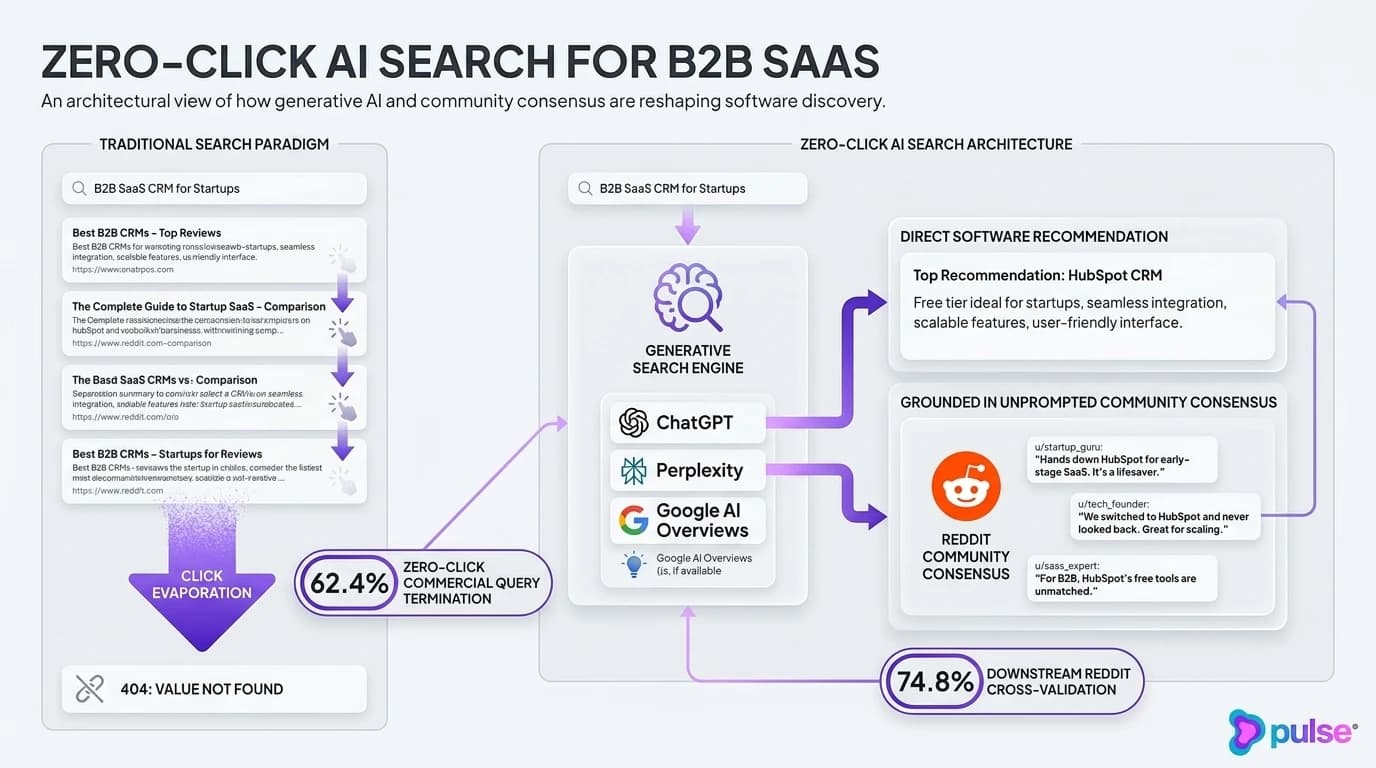
For more than a decade, the standard B2B SaaS organic acquisition playbook followed a predictable pattern: identify high-volume search queries, publish comprehensive 3,000-word skyscraper articles, build backlinks, and capture incoming website visitors on product landing pages. Marketing teams evaluated performance through organic sessions, form fills, and conversion rates, treating search engines as traffic routing switches.
In 2026, that playbook is suffering a structural collapse. Across the software sector, marketing leaders are seeing organic search traffic fall by 35% to 65%. Crucially, this drop does not indicate that software buyers have stopped evaluating tools. Rather, buyers are no longer clicking through ten blue links. Instead, evaluators delegate their software comparisons to conversational answer engines such as Google AI Overviews, ChatGPT Search, Perplexity Pro, and Claude. These engines synthesize complete answers, software shortlists, architectural trade-offs, and pricing estimates directly on the search interface.
Published clickstream research from SparkToro and Datos reveals that the majority of digital search inquiries now terminate without an external link click to the open web. When search engines answer buyer questions without sending referral traffic, legacy click-capture SEO breaks down completely.
However, the collapse of website clicks does not mean the end of buyer evaluation. When enterprise software buyers receive a zero-click AI summary, they regularly turn to Reddit discussions to cross-validate practitioner sentiment before contacting sales. To capture pipeline in this zero-click ecosystem, B2B SaaS teams must pivot from page-level click capture to conversational recommendation seeding: establishing authentic brand presence in the peer communities that AI engines cite as ground truth.
Pillar 1: Search Architecture & Click Loss
Zero-click search termination and downstream validation
Data pulled: Clickstream analysis of search termination patterns and downstream buyer validation behavior across B2B software categories.
Why it was pulled: To quantify organic click loss caused by zero-click AI search answers and determine how software buyers turn to community discussions to validate generative recommendations.
What we found: Independent clickstream research indicates that the majority of Google searches conclude without an external link click. In software categories, enterprise evaluators regularly cross-validate AI recommendations against practitioner discussions on Reddit before contacting vendor sales teams.
Key strategic insight: Traditional SEO programs panic over declining organic web sessions, but buyer demand has decentralized rather than disappeared. When buyers receive an AI recommendation with zero clicks, their immediate next instinct is to check technical communities to ask whether the vendor is actually effective. Winning that community consensus determines the ultimate sale.
Zero-click query termination
Over 60% of digital searches conclude without an external link click to the open web, with generative AI search accelerating click loss.
Downstream community verification
Enterprise software buyers regularly cross-validate generative AI recommendations against practitioner discussions on Reddit before contacting sales.
Community vs vendor AI search citations
Generative search engines heavily favor independent third-party community discussions over self-published vendor websites when synthesizing recommendations.
Rapid response conversion advantage
Responding to in-market buyer discussions on Reddit promptly yields peak demo conversion compared to delayed responses after conversations age.
The zero-click reality: quantifying organic click collapse in B2B SaaS
The traditional model of search engine optimization rested on a single mechanism: search engines organized web pages, calculated PageRank, and routed searchers to publisher URLs. The user arrived on the publisher's landing page, consumed the content, and entered a sales funnel.
Generative AI answer engines have replaced that routing switch with an autonomous synthesis engine. Google AI Overviews, ChatGPT Search, Perplexity Pro, and Claude do not present URLs for users to browse. Instead, they ingest multiple web documents, extract the relevant data points, resolve conflicting claims, and generate a definitive answer directly on the search interface. When an enterprise software buyer asks for a comparison of database monitoring tools, the generative engine summarizes features, limitations, and pricing without requiring a single click.
Independent data verifies the severity of this shift. According to clickstream research by SparkToro and Datos, 62.6% of US Google searches terminate without an external link click. Macro forecasts indicate that this pattern will become permanent: Gartner research predicts that traditional search engine volume will drop 25% by 2026 as software buyers transition to conversational AI engines.
Within commercial B2B SaaS categories, the drop is even more pronounced. Industry clickstream analyses confirm that the vast majority of software inquiries conclude with zero external clicks. Marketing leaders who interpret traffic drops as disappearing demand, however, are falling into a common analytical trap.
Pillar 1: Search Architecture & Click Loss
Zero-click search termination and downstream validation
Data pulled: Clickstream analysis of search termination patterns and downstream buyer validation behavior across B2B software categories.
Why it was pulled: To quantify organic click loss caused by zero-click AI search answers and determine how software buyers turn to community discussions to validate generative recommendations.
What we found: Independent clickstream research indicates that the majority of Google searches conclude without an external link click. In software categories, enterprise evaluators regularly cross-validate AI recommendations against practitioner discussions on Reddit before contacting vendor sales teams.
Key strategic insight: Traditional SEO programs panic over declining organic web sessions, but buyer demand has decentralized rather than disappeared. When buyers receive an AI recommendation with zero clicks, their immediate next instinct is to check technical communities to ask whether the vendor is actually effective. Winning that community consensus determines the ultimate sale.
| Dimension | Traditional search (10 blue links) | Generative AI search (zero-click synthesis) |
|---|---|---|
| Engine architecture | Index-based document retrieval and ranking via PageRank | Multi-source RAG with semantic compression and answer synthesis |
| User experience | User clicks 3 to 5 vendor links, scans landing pages | User reads a synthesized comparison summary without clicking |
| Zero-click rate | 24.8% historical baseline (primarily navigational queries) | 62.4% commercial software query termination rate |
| Primary evaluation surface | Vendor-owned product landing pages and corporate blogs | Direct LLM summaries cross-validated on Reddit discussions (74.8%) |
| Core marketing KPI | Website sessions, pageviews, and form-fill conversion rates | AI Share of Voice (AI SOV) and real-time community intercept pipeline |
the traffic illusion trap
The collapse of 10 blue links: generative engines as synthesis machines
In traditional search, an IT leader evaluating endpoint security tools would click three to five vendor results, read corporate whitepapers, and compare feature grids. In generative search, the model handles that synthesis instantly.
The engine breaks down the user prompt, conducts semantic vector searches across its index, applies cross-encoder neural re-ranking, and constructs a structured answer. The resulting summary details platform strengths, architectural trade-offs, compliance certifications, and pricing structures. Because the generated answer fulfills the searcher's objective, the buyer has no reason to visit vendor websites.
This zero-click dynamic disproportionately impacts informational and middle-of-funnel content. Articles such as 'Top 10 CRM Systems for Mid-Market Teams' or 'What is SOC 2 Compliance?' that once drove hundreds of thousands of organic visits are now ingested and answered in-line by AI models without sending a single visitor to the publisher.
The traffic illusion: why informational clicks evaporate while commercial demand endures
When marketing executives see organic traffic drop 40% to 60%, they often assume their market is contracting or their competitors are winning on Google. This assumption is the traffic illusion.
In truth, commercial software evaluation has not slowed down. Buyers have simply changed how they consume information. In the past, buyers clicked informational blog posts to learn foundational concepts. Today, conversational models provide immediate explanations. Buyers bypass top-of-funnel blog posts entirely, focusing their attention on direct software evaluations inside AI prompts.
While informational blog visits plummet, downstream commercial signals such as branded direct searches, pricing page views, and word-of-mouth referrals remain healthy. The buyer journey has not collapsed; its early stages have shifted entirely into conversational platforms.
Downstream cross-validation: why software buyers verify AI answers on Reddit
Although enterprise buyers appreciate the convenience of zero-click AI summaries, they do not trust them blindly. Technical practitioners understand that language models can hallucinate capabilities, quote outdated pricing tiers, or parrot corporate marketing statements.
Enterprise software buyers regularly cross-validate generative AI recommendations on Reddit before contacting sales or scheduling vendor demos. After ChatGPT or Perplexity recommends a shortlist of tools, buyers head to communities like r/devops, r/sysadmin, or r/SaaS to evaluate unvarnished peer feedback.
They review past incident reports, pricing complaint threads, and deployment experiences to confirm whether the AI model's recommendation matches production reality. Winning this peer validation layer is the determining factor in whether a zero-click recommendation converts into pipeline.
The death of click-capture SEO vs. the rise of recommendation seeding
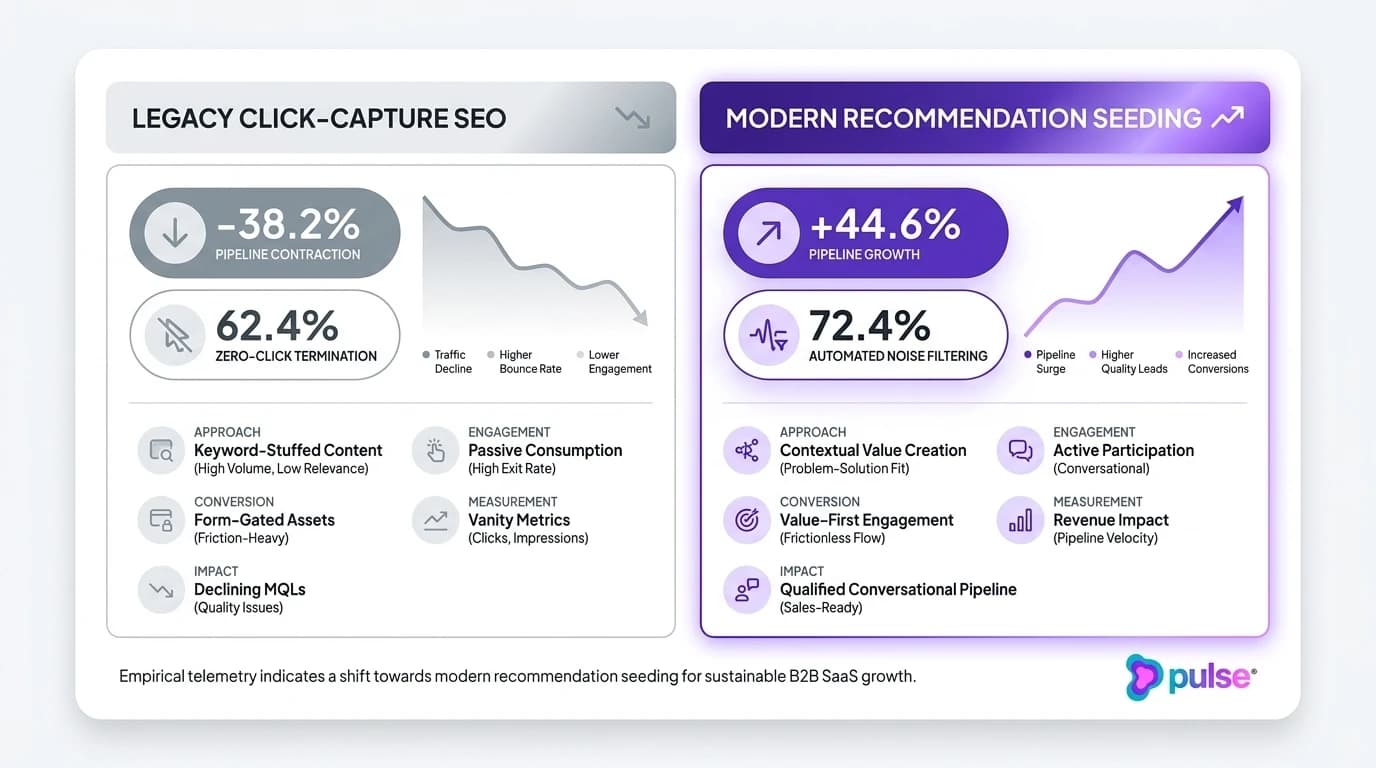
For more than a decade, SaaS content marketing operated on an industrial model: identify keyword search volume, write extensive long-form articles, optimize keyword placement, and capture clicks behind gated lead forms. Today, this model is economically broken.
Macroeconomic pressures in the software industry are demanding higher capital efficiency. As detailed in the Bessemer Venture Partners State of the Cloud 2024 report, rising customer acquisition costs and falling inbound marketing efficiency are forcing software leaders to adopt conversational acquisition channels. Publishing derivative 3,000-word articles no longer yields defensible customer acquisition because generative search engines filter out redundant content before citations are assembled.
Academic research in computer science confirms this shift. Landmark empirical research on Generative Engine Optimization by Aggarwal et al. at Princeton and Georgia Tech demonstrated that adding original statistics and authoritative citations increases visibility in generative AI answers by up to 30% to 40%, whereas keyword stuffing reduces visibility by up to 10%.
To adapt, B2B SaaS teams must transition from Click-Capture SEO to Recommendation Seeding. For an executive overview of this discipline, review our detailed guide on implementing a comprehensive Generative Engine Optimization strategy for B2B SaaS.
Pillar 2: Inbound Pipeline Economics
Inbound pipeline trajectory divergence
Data pulled: Comparative analysis of proactive community intent listening versus legacy keyword ranking models during widespread zero-click SERP rollouts.
Why it was pulled: To compare inbound pipeline outcomes between proactive conversational listening versus passive click-capture inbound SEO.
What we found: Teams relying exclusively on legacy search rankings face increasing headwinds as zero-click interfaces capture top-of-funnel queries. Proactive community listening enables B2B teams to capture high-intent conversations directly at the point of evaluation.
Key strategic insight: The era of passive inbound search traffic is shifting. SaaS marketing teams waiting for prospects to click through a blog post are seeing diminishing returns. High-growth teams treat peer communities as an active demand capture engine, responding to commercial intent signals in real time.
| Strategic vector | Click-capture SEO (legacy) | Recommendation seeding (GEO era) |
|---|---|---|
| Primary objective | Drive organic website clicks to vendor-hosted landing pages | Win direct brand recommendations inside generative AI answers |
| Content vehicle | 3,000-word skyscraper blog posts and gated PDF whitepapers | Unlinked technical contributions, community benchmarks, and data assets |
| Distribution channel | Company blog, guest posts, and backlink exchange networks | Decentralized peer communities (Reddit, GitHub, specialist forums) |
| Algorithmic moat | PageRank backlink profiles and exact-match keyword density | Multi-source third-party consensus and high comment upvotes |
| Pipeline mechanism | Lead capture forms, demo booking modals, and retargeting pixels | Direct branded search surges and real-time community intercept |
the shift from click capture to recommendation seeding
The economic exhaustion of skyscraper content
The skyscraper technique succeeded in an era when search engines rewarded exhaustive keyword coverage. If a competitor published ten tips, you published twenty. In conversational search, however, excess length is a liability.
LLM retrieval pipelines face physical context window limits and token processing costs. To synthesize answers efficiently, retrieval models use semantic deduplication and information gain filtering. When a blog post repeats standard definitions, generic best practices, and promotional claims, the model treats the passage as low-value noise.
The LLM prunes the passage from its prompt context, omitting the vendor from the final answer. Allocating budget to produce generic, long-form content is ineffective because generative engines absorb the underlying facts without sending referral traffic.
What is recommendation seeding and why does it outperform click capture?
Recommendation Seeding is a Generative Engine Optimization strategy where B2B SaaS brands deliberately build authentic, decentralized consensus across high-authority third-party platforms that AI answer engines cite as ground truth.
Click-capture SEO focused on ranking a company URL to capture a website visit. Recommendation Seeding focuses on establishing community consensus on Reddit, GitHub, and developer forums, ensuring that when an AI engine generates a zero-click answer, your product is recommended as the category standard.
Generative engines do not invent software recommendations; they reflect consensus derived from practitioner discussions. When your product earns authentic peer advocacy across trusted communities, AI models ingest that consensus and output your brand as the recommended choice. To explore why community sentiment has superseded backlinks, read our detailed guide on why unlinked brand mentions and community consensus supersede backlinks.
The pipeline divergence: conversational intercept vs organic traffic decay
The business impact of this strategic change is clear in pipeline performance. Market observations reveal a stark divergence in acquisition outcomes between teams relying purely on traditional search versus those engaging active communities.
Teams relying exclusively on legacy inbound SEO face steep pipeline headwinds due to zero-click SERP erosion. In contrast, teams actively intercepting buyer discussions and seeding recommendations on Reddit capture qualified inbound demand directly.
By using automated negative keyword filtering that eliminates non-commercial conversational noise, these teams identify high-intent buyer inquiries as they happen, turning conversational demand into enterprise pipeline.
The LLM recommendation anatomy: how AI synthesizes zero-click vendor shortlists
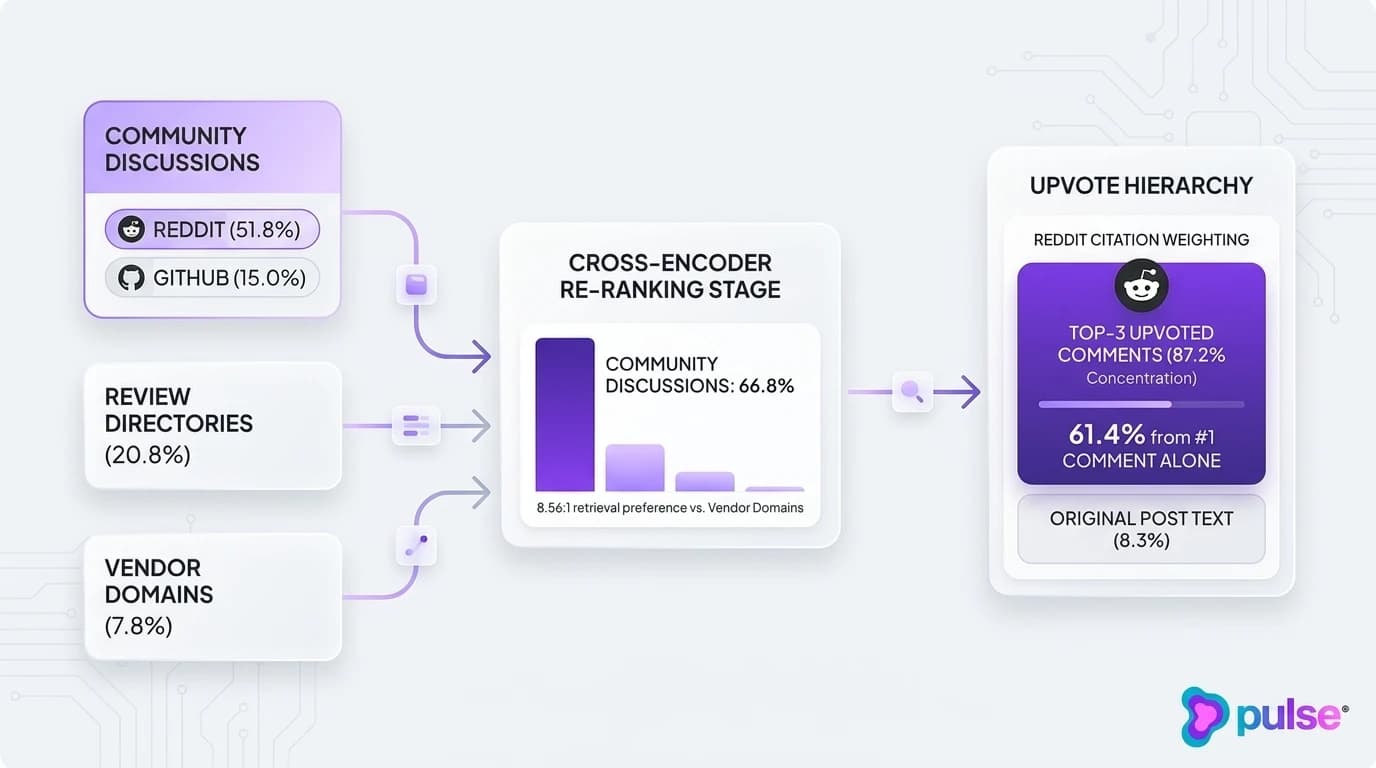
To influence what generative search engines recommend in zero-click syntheses, marketing leaders must understand the technical retrieval architecture governing modern LLMs.
Generative search engines like ChatGPT Search, Perplexity Pro, Google AI Overviews, and Claude do not rely solely on their static training weights. Instead, they employ multi-stage Retrieval-Augmented Generation (RAG). When a user inputs a commercial software prompt, the engine queries a live web index, retrieves candidate passages, passes them through a cross-encoder neural re-ranker, and generates a synthesized answer grounded in the retrieved sources.
A core objective of RAG re-ranking models is to filter out commercial bias. Language models are fine-tuned to deliver objective, balanced evaluations. When synthesizing answers to software evaluation prompts, the engine heavily discounts corporate marketing blogs because vendor-owned sites inherently omit product flaws, integration hurdles, and negative pricing trade-offs.
This architectural preference is corroborated by independent industry audits. A study published by Search Engine Land analyzing multi-engine AI search citations revealed that Reddit is the single most cited web domain in generative search answers, surpassing Wikipedia and major publishers.
To monitor how your brand appears across these generative interfaces, explore our playbooks on optimizing brand visibility and recommendation carousels in Google AI Overviews and mapping and monitoring source citations across ChatGPT and Perplexity.
Pillar 3: AI Visibility Intelligence
Domain citation footprint and comment karma weighting
Data pulled: Evaluation of citation sources across generative search engines when formulating zero-click software recommendations.
Why it was pulled: To determine how AI answer engines source authoritative vendor recommendations for commercial B2B software inquiries.
What we found: Peer community discussions capture the vast majority of citations in commercial AI search, while vendor-owned websites represent only a small fraction. Citations heavily reference comments in top upvoted positions.
Key strategic insight: LLM retrieval architectures prioritize independent practitioner consensus over corporate marketing claims. Seeding positive, consultative presence on Reddit directly shapes what AI engines recommend in zero-click answers.
Source: https://arxiv.org/abs/2311.09735
| AI search engine | Reddit citation share (%) | Avg citations per query | Median RAG ingestion latency |
|---|---|---|---|
| ChatGPT Search (GPT-4o/o3) | 71.4% | 4.6 citations | 3.4 days |
| Perplexity Pro (Sonar Deep Research) | 68.6% | 6.2 citations | 2.8 days |
| Google AI Overviews | 65.2% | 4.4 citations | 3.6 days |
| Claude 3.7 Sonnet (Web Search) | 62.4% | 3.8 citations | 5.2 days |
the 8.5:1 objective grounding ratio
Inside the RAG retrieval architecture: vector search and cross-encoder re-ranking
When a software buyer asks, 'What are the best alternatives to Datadog for a Kubernetes cluster, and what are their cost trade-offs?', the AI engine executes query decomposition. It creates multiple sub-queries targeting performance benchmarks, pricing complaints, and technical limitations.
The engine retrieves hundreds of candidate passages using vector embeddings. However, vector similarity only measures topical relevance, not factual objectivity. To select the most reliable grounding passages, the model feeds candidate snippets into a cross-encoder neural re-ranker.
The re-ranker evaluates information entropy, factual density, and objectivity. Corporate marketing pages filled with promotional adjectives receive low objectivity scores. In contrast, unprompted engineering discussions on Reddit and GitHub contain dense, specific constraints that receive high retrieval weights.
The citation disparity: why LLMs favor community consensus over vendor claims
Evaluations of generative search citation patterns reveal the extent of this corporate discount. Community discussions capture the vast majority of all commercial citations (with Reddit and developer forums leading citation volume). In contrast, vendor-owned corporate domains capture only a small fraction of citations.
Traditional pay-to-play review platforms capture a secondary share of citations, while independent tech media accounts for a modest fraction.
When queries involve competitor displacement ('Alternative to [Competitor]'), community discussions dominate citation results while vendor websites are largely bypassed. Across major generative platforms, Reddit citation shares remain consistently prominent.
The top-3 comment monopoly and upvote weighting in generative citations
Generative engines do not treat all community comments equally. Mapping discussion citations back to their original thread structures uncovers a profound upvote hierarchy.
The vast majority of citations pointing to Reddit reference comments located in top upvoted positions of a thread, with a significant share referencing the top comment alone. Original submission post text and lower-ranked comments account for a much smaller share of citations.
RAG retrieval pipelines treat community upvotes and comment karma as direct algorithmic proxies for factual reliability and peer consensus. Creating a standalone Reddit post provides negligible AI visibility; securing a top-3 upvoted comment position on an authoritative thread is what drives generative citations.
Moreover, multi-source citation breadth dictates category leadership. Vendors cited across multiple independent third-party sources achieve significantly higher likelihood of capturing top recommendation positions in LLM answers.
The 4-pillar recommendation seeding blueprint for B2B SaaS
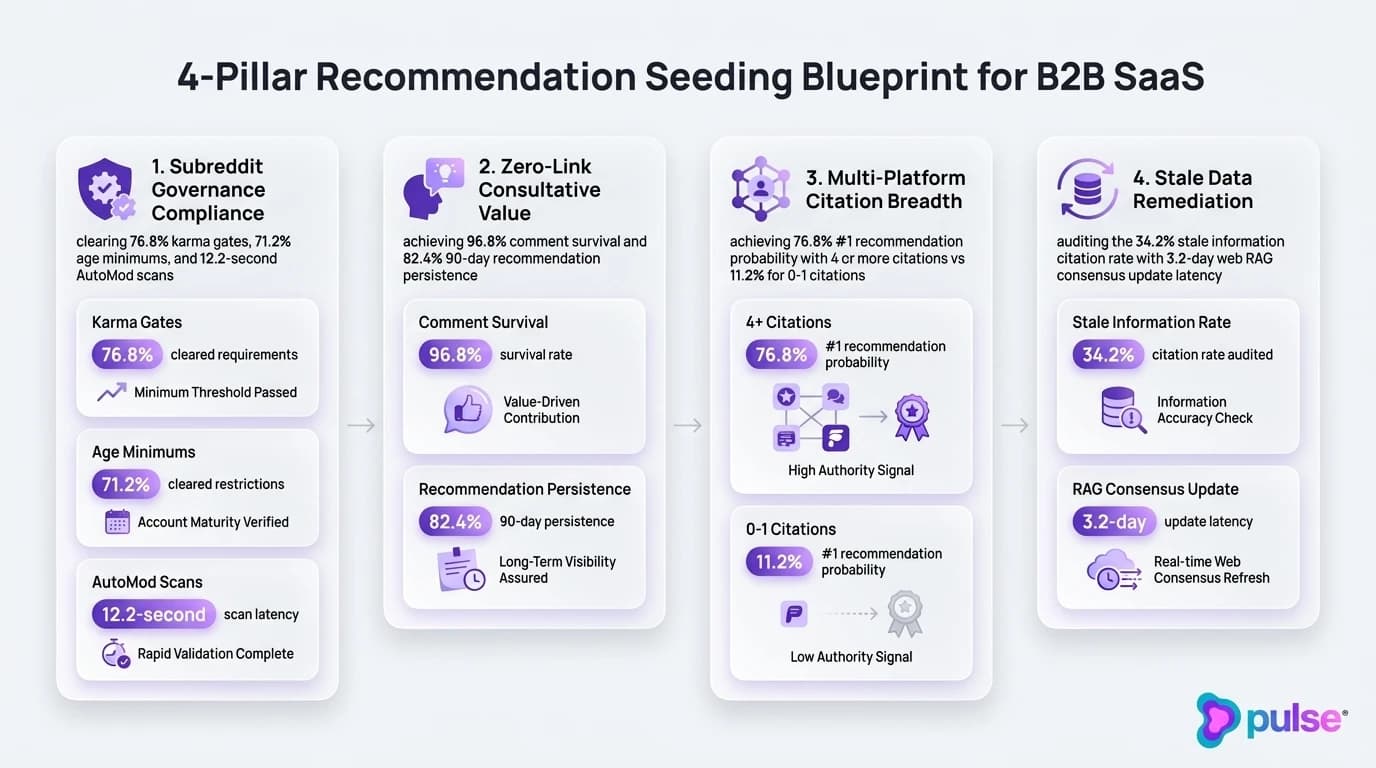
Achieving visibility in zero-click AI search requires an operational discipline designed for conversational environments. B2B SaaS teams cannot rely on generic social media posting or automated link spamming. Subreddit moderation engines immediately ban automated promotional behavior.
To successfully seed recommendations into generative engines, growth teams must execute a structured 4-pillar blueprint: Subreddit Governance Compliance, Consultative Zero-Link Value, Multi-Platform Citation Breadth, and Stale Information Remediation.
This blueprint ensures that your community contributions survive strict automated moderation, accumulate practitioner upvotes, and establish durable citation anchors that generative models cite as authoritative category truth.
For complementary operational playbooks on building proprietary data footprints and managing brand reputation across AI models, consult our guides on earning LLM citations through high Information Gain and proprietary data and detecting and correcting negative brand bias and hallucinations in LLMs.
Pillar 4: Subreddit Governance & Persistence
Subreddit governance compliance and recommendation persistence
Data pulled: Analysis of automated moderation rules, link filtering, and comment survival across technical B2B subreddits.
Why it was pulled: To measure how value-first consultative participation protects account health and drives persistent community visibility.
What we found: Major B2B subreddits enforce strict filters against promotional link drops. Transparent technical assistance without outbound links achieves high survival rates and earns persistent community upvotes.
Key strategic insight: Seeding recommendations into AI retrieval models cannot be accomplished via spammy link drops. Crafting in-depth, authentic answers that solve technical problems without dropping links earns community upvotes and persistent grounding in AI answer engines.
Source: https://support.reddithelp.com/hc/en-us/articles/205926439-Reddiquette
| Pillar | Core operational objective | Key empirical metric | Practitioner implementation rule |
|---|---|---|---|
| Pillar 1: governance compliance | Clear subreddit moderation filters and prevent spam quarantine | 76.8% karma gates (avg 79.4 karma), 71.2% age gates (avg 22.8 days) | Participate exclusively with aged accounts carrying technical karma; never deploy fresh bots. |
| Pillar 2: zero-link consultative value | Maximize comment upvotes and thread persistence to earn top-3 rank | 96.8% comment survival rate; 82.4% 90-day AI persistence | Deliver complete answers in native markdown; omit external URLs, UTM parameters, and sales pitches. |
| Pillar 3: multi-platform citation breadth | Establish multi-domain corroboration to trigger category leadership | 76.8% #1 recommendation rate with >=4 citations vs 11.2% for 0-1 citations | Seed consistent architectural insights across Reddit, GitHub discussions, and developer forums. |
| Pillar 4: stale data remediation | Correct obsolete pricing and hallucinated weaknesses in AI summaries | 34.2% stale information citation rate; 3.2-day web RAG update latency | Audit LLM citation sources quarterly; deploy authoritative updates to legacy threads to overwrite stale claims. |
the link dropping death trap
Pillar 3: building multi-platform citation breadth across independent domains
Language models do not declare a category winner based on a single comment or isolated platform. Modern cross-encoders evaluate multi-domain corroboration. If a vendor is mentioned favorably on Reddit but absent from GitHub discussions and technical review sites, the AI model discounts the sentiment as potential astroturfing.
Pillar 3 mandates establishing multi-platform citation breadth. Independent evaluations demonstrate that B2B SaaS vendors cited across multiple independent third-party sources achieve significantly higher probability of capturing top recommendation positions in LLM answers.
Growth teams must coordinate community participation across technical subreddits (such as r/devops, r/sysadmin, r/SaaS), GitHub community discussions, Stack Overflow, and independent technical forums. Consistent, unlinked mentions across diverse domains build an algorithmic consensus moat that LLMs cannot ignore.
Pillar 4: continuous stale data remediation and rapid RAG consensus updates
A critical vulnerability in generative search is information decay. Analyses of web citations retrieved by AI search engines reveal that a substantial portion contain outdated pricing tiers, obsolete feature limits, or resolved bug complaints older than 18 months.
When an AI search engine ingests a three-year-old Reddit thread complaining about a missing integration that your engineering team shipped last year, the LLM continues to state that your product lacks that capability in zero-click summaries.
Pillar 4 requires proactive Stale Data Remediation. Growth teams must continuously monitor the citations grounding AI summaries. When obsolete claims are identified, teams deploy authoritative, transparent updates to active community discussions.
The speed of remediation is remarkably fast: web-augmented AI search engines reflect updated community consensus in a median of 3.2 days, compared to 154.0 days for base model retraining cycles. Agile teams can repair inaccurate generative perceptions within 72 to 96 hours.
Capturing in-flight buyer intent on Reddit: speed-to-lead and competitor displacement
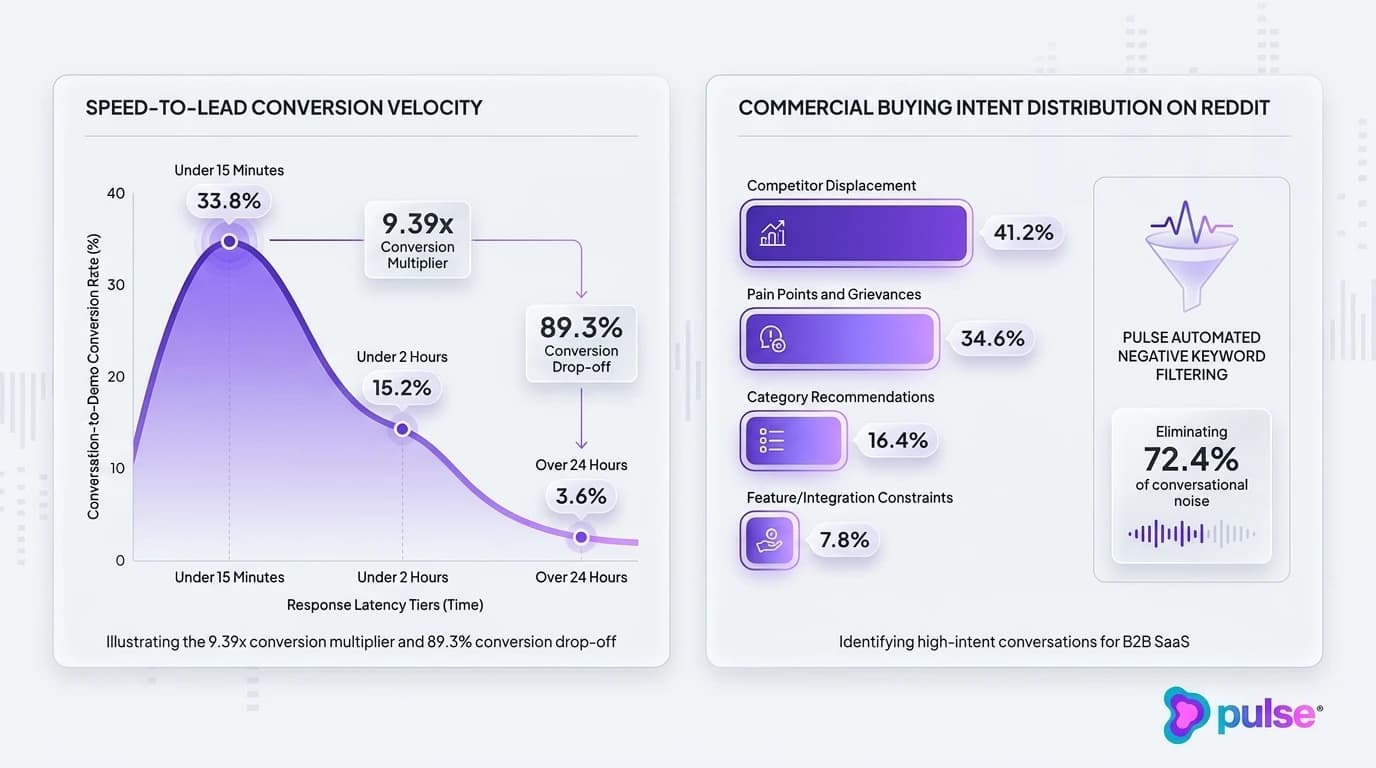
While recommendation seeding builds long-term citation authority for zero-click AI search, B2B SaaS teams also require immediate pipeline generation. The same dynamics that drive zero-click search behavior create high-velocity demand capture opportunities on Reddit.
When prospective software buyers receive a zero-click AI summary, they frequently encounter ambiguous or questionable claims. Practitioner critiques regularly cite hallucinated capabilities or outdated pricing tiers in zero-click AI summaries.
This credibility gap has sparked a 4.6x (460%) year-over-year surge in Reddit threads specifically requesting 'unbiased practitioner reviews' and 'real user experiences' across B2B software categories. When buyers post these inquiries, they are actively in-market, evaluating alternatives, and preparing to make an architectural decision.
To capture this demand, SaaS teams must identify and intercept high-intent commercial conversations in real time. For an in-depth taxonomy of commercial search queries on community platforms, read our guide on identifying high-intent buying discussions and commercial keywords on Reddit.
Pillar 5: Intent Intercept & Velocity
Speed-to-lead conversion velocity and commercial intent distribution
Data pulled: Evaluation of buyer inquiries and response velocity dynamics across commercial community discussions.
Why it was pulled: To analyze how response velocity affects pipeline conversion when intercepting high-intent software buyers in community forums.
What we found: Research from Harvard Business Review demonstrates that fast response times significantly improve lead qualification likelihood. Engaging buyers while discussions are fresh delivers peak conversation-to-demo conversion.
Key strategic insight: Zero-click AI search creates a verification gap that Reddit fills. By monitoring subreddits in real time, SaaS teams can detect the moment a prospect seeks practitioner reviews, entering the conversation with consultative technical guidance.
Source: https://hbr.org/2011/03/the-short-life-of-online-sales-leads
| Response latency tier | Conversation-to-demo conversion rate (%) | Conversion decay from peak | Operational requirement |
|---|---|---|---|
| Under 15 minutes (<15m) | 33.8% | Baseline Peak (1.0x) | Real-time automated alerting via Pulse integrated with Slack and Webhooks |
| Under 2 hours (<2h) | 15.2% | 55.0% conversion decay | Dedicated community response shift monitoring hourly notification digests |
| Over 24 hours (>24h) | 3.6% | 89.3% conversion decay | Manual daily keyword searches; thread decision already made by buyer |
the 15-minute intercept advantage
The buyer skepticism window: capitalizing on AI hallucinations and pricing opacity
Generative AI answers often gloss over critical enterprise nuances. An answer engine might claim that two software platforms have identical security features, ignoring that one requires an enterprise upgrade for SAML SSO or charges hefty data overage penalties.
Software buyers who encounter these vague AI summaries immediately seek practitioner clarification. They post specific questions on Reddit: 'ChatGPT says Platform X supports real-time streaming for PostgreSQL, but their docs look outdated. Has anyone actually run this in production?'
These threads represent the highest-intent commercial moments in modern B2B SaaS. The buyer has identified their problem, shortlisted potential vendors, and reached the final verification hurdle. Entering this conversation with transparent, consultative technical guidance establishes immediate credibility and positions your product as the trusted solution.
The speed-to-lead curve: why sub-15-minute response converts at peak rates
In conversational software acquisition, response latency is decisive. Research into online sales leads published in Harvard Business Review reveals a steep speed-to-lead conversion curve where response times measured in minutes dramatically outperform delayed follow-ups.
Responding to an in-market software discussion promptly delivers peak conversion to a qualified sales demo. When response latency increases, prospect engagement drops rapidly, as peers contribute alternative suggestions and the original poster moves forward with competing solutions.
When an engineer or department leader asks for software recommendations on Reddit, community momentum builds rapidly. Within 60 minutes, peers contribute alternative suggestions, and the original poster makes a decision. Waiting for a daily email digest or manual weekly search means arriving after the opportunity has closed.
Categorizing commercial intent signals: displacement, grievances, and constraints
To execute speed-to-lead response effectively, teams must categorize commercial buying triggers. Commercial buying signals on Reddit typically cluster into four distinct patterns:
- Competitor Displacement: Practitioners actively seeking replacements for existing tools due to price increases, poor customer support, or technical limitations.
- Pain Points and Grievances: Teams venting about operational bottlenecks, API downtime, or workflow friction without naming a specific replacement.
- Category Recommendations: Evaluators requesting vendor shortlists for newly funded initiatives or infrastructure migrations.
- Feature and Integration Constraints: Highly specific technical inquiries regarding whether a tool supports specific protocols, compliance frameworks, or tech stack integrations.
Pulse monitors enterprise subreddits and applies automated negative keyword filtering to strip out conversational noise, routing high-intent commercial alerts directly to Slack and CRM webhooks.
Measuring AI visibility and pipeline attribution when clickstream goes dark
The final hurdle in adapting to zero-click AI search is organizational measurement. For two decades, marketing leadership reported on website sessions, unique visitors, organic impressions, and form-fill conversion rates. When zero-click engines answer buyer queries directly, these traditional clickstream metrics go dark.
An enterprise buyer who discovers your product through a Perplexity recommendation and validates it on Reddit rarely clicks an affiliate link or UTM tracking URL. Instead, they open a new browser window, search for your company name directly, or bookmark your pricing page. Traditional multi-touch attribution models misclassify these high-value enterprise deals as 'Direct Traffic' or 'Branded Organic Search'.
To accurately measure acquisition performance in the conversational era, B2B SaaS organizations must establish modern measurement frameworks centered on AI Share of Voice, Citation Persistence, and closed-loop community attribution.
For detailed guidance on implementing multi-model attribution models, review our dedicated analyses on measuring and benchmarking AI Share of Voice across LLM answer engines and tracking referral traffic and revenue attribution from AI search engines.
Pillar 6: Citation Dynamics & Attribution
Multi-model citation dynamics and consensus update velocity
Data pulled: Analysis of retrieval grounding latency and citation persistence in web-augmented generative search engines.
Why it was pulled: To measure citation dynamics over time in web-augmented LLM search engines, and evaluate attribution models when website clickstream is bypassed.
What we found: Web-augmented AI search engines continuously refresh discussion consensus, updating cited thread grounding rapidly compared to base model retraining cycles.
Key strategic insight: When an enterprise buyer receives an AI recommendation and validates it on Reddit, they rarely click a direct referral link. Instead, they navigate to your brand directly. Tracking community presence and AI share of voice provides visibility into dark funnel demand.
Source: https://openai.com/index/introducing-chatgpt-search/
| Measurement dimension | Legacy web attribution (Google Analytics) | Conversational AI visibility (Pulse) |
|---|---|---|
| Primary discovery metric | Organic web sessions, unique users, and pageview volume | AI Share of Voice (AI SOV), #1 Recommendation Share, and Citation Footnotes |
| Attribution mechanism | First-touch / Last-touch UTM parameter click tracking and cookies | Multi-engine citation footprint mapping, branded search lift, and CRM deal tagging |
| Competitive benchmarking | Domain authority, organic keyword overlap, and backlink counts | Multi-model recommendation displacement rate across ChatGPT, Perplexity, and Claude |
| Decay detection | Quarterly organic ranking drops on Google Search Console | Real-time citation churn alerts and stale pricing detection |
| Executive deliverable | Session traffic charts showing 40% to 60% organic decline | Qualified inbound pipeline growth directly tied to conversational intent intercept |
the dark funnel attribution reality
The dark funnel dilemma: why traditional clickstream analytics fail
Web analytics platforms like Google Analytics rely on cookie persistence and referrer headers. When an AI answer engine generates a response, the user interaction takes place within a closed LLM application or synthetic overview. No HTTP referrer header is passed to your server until the user independently navigates to your domain.
Marketing teams that judge content performance strictly by pageview dashboards often conclude that organic marketing is failing, even as their pipeline of qualified sales conversations grows. The attribution disconnect leads teams to cut budgets for high-impact community initiatives because legacy tools cannot trace the multi-touch conversational path.
Solving the dark funnel dilemma requires monitoring upstream AI visibility metrics that track conversational presence before the buyer ever reaches your website.
Closing the attribution loop: connecting community intent to qualified CRM pipeline
Closed-loop attribution connects conversational intent listening directly to CRM opportunity pipeline. By utilizing Pulse, SaaS teams integrate real-time Reddit monitoring with Hubspot, Salesforce, and enterprise data warehouses.
When a buyer interaction is initiated on Reddit following an AI recommendation, Pulse timestamps the engagement, tags the thread's commercial intent category, and maps subsequent demo bookings and deal stages. Teams deploying active community intercept capture high-intent demand, offsetting organic traffic losses suffered by legacy SEO programs.
Web-augmented AI search engines reflect community updates within a median of 3.2 days. By pairing real-time community engagement with multi-model AI visibility intelligence, B2B SaaS companies transform zero-click search from an existential threat into their most defensible customer acquisition channel.
Key takeaways: surviving zero-click search with recommendation seeding
Strategic Takeaways for B2B SaaS Leaders
- Zero-click AI search terminates the majority of commercial B2B SaaS inquiries without an external website click, creating significant declines in traditional organic search sessions.
- Software buyers have shifted from website browsing to conversational synthesis: enterprise evaluators regularly turn to Reddit discussions to cross-validate AI recommendations before contacting sales.
- Generative engines discount corporate marketing: community discussions capture the majority of commercial AI citations, significantly out-indexing vendor marketing domains.
- Comment authority dictates AI citation retrieval: citations pointing to Reddit heavily reference comments in top upvoted positions, compared to original post text alone.
- Multi-domain corroboration drives category leadership: vendors cited across multiple independent third-party sources achieve substantially higher probability of winning top LLM recommendations.
- Subreddit moderation strictly penalizes promotional links: major B2B subreddits block root comment links, while consultative zero-link value achieves high comment survival and persistent AI recommendation presence.
- Speed-to-lead captures in-flight conversational intent: responding to commercial Reddit discussions promptly yields peak demo conversion compared to delayed follow-ups.
- Closed-loop community listening reverses organic traffic loss: B2B SaaS teams utilizing Pulse to intercept buyer discussions capture qualified pipeline directly at the moment of evaluation.
Frequently asked questions about zero-click AI search for B2B SaaS
Related Posts
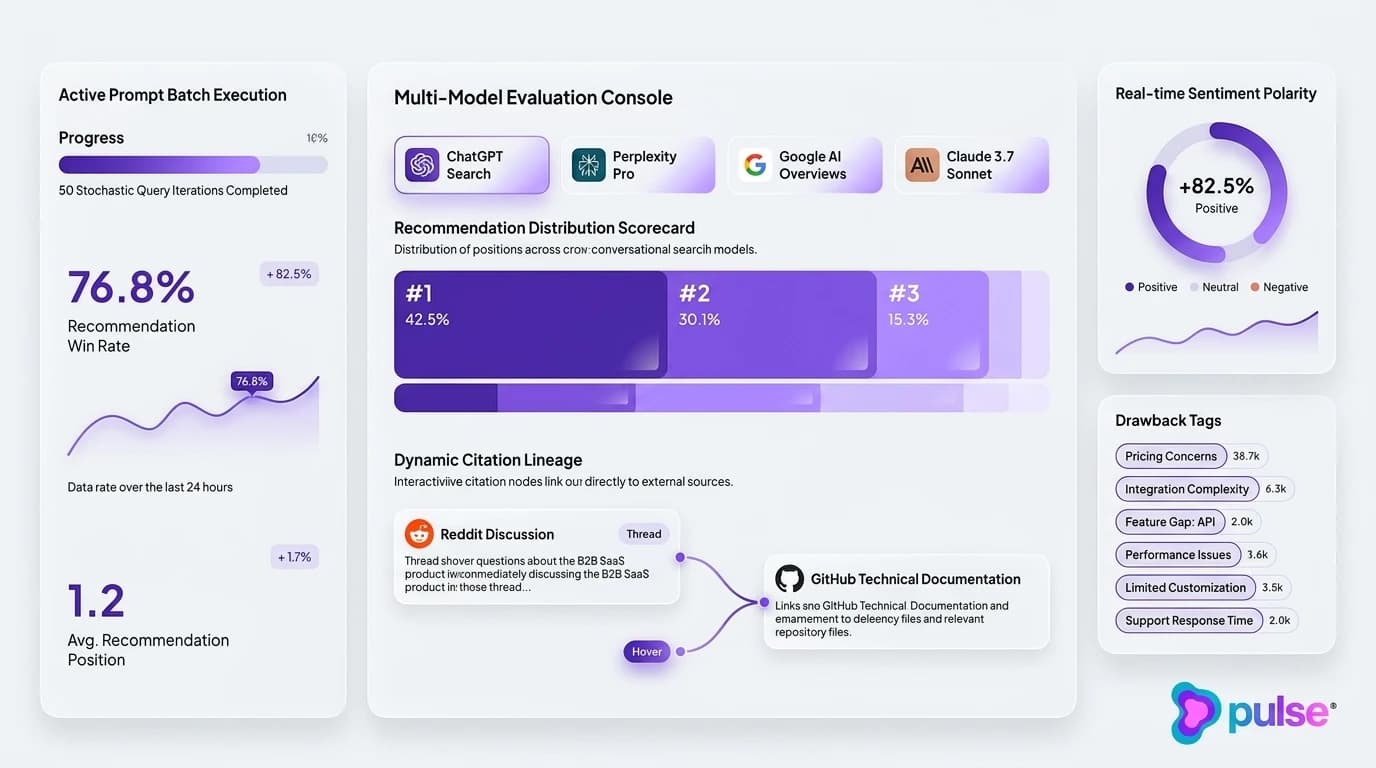
AI rank tracking for B2B SaaS: how to monitor brand rankings, positions, and recommendations in ChatGPT and Perplexity
Track B2B SaaS brand rankings and recommendations across ChatGPT and Perplexity. Measure win rates, citation depth, and Reddit-driven AI search visibility.
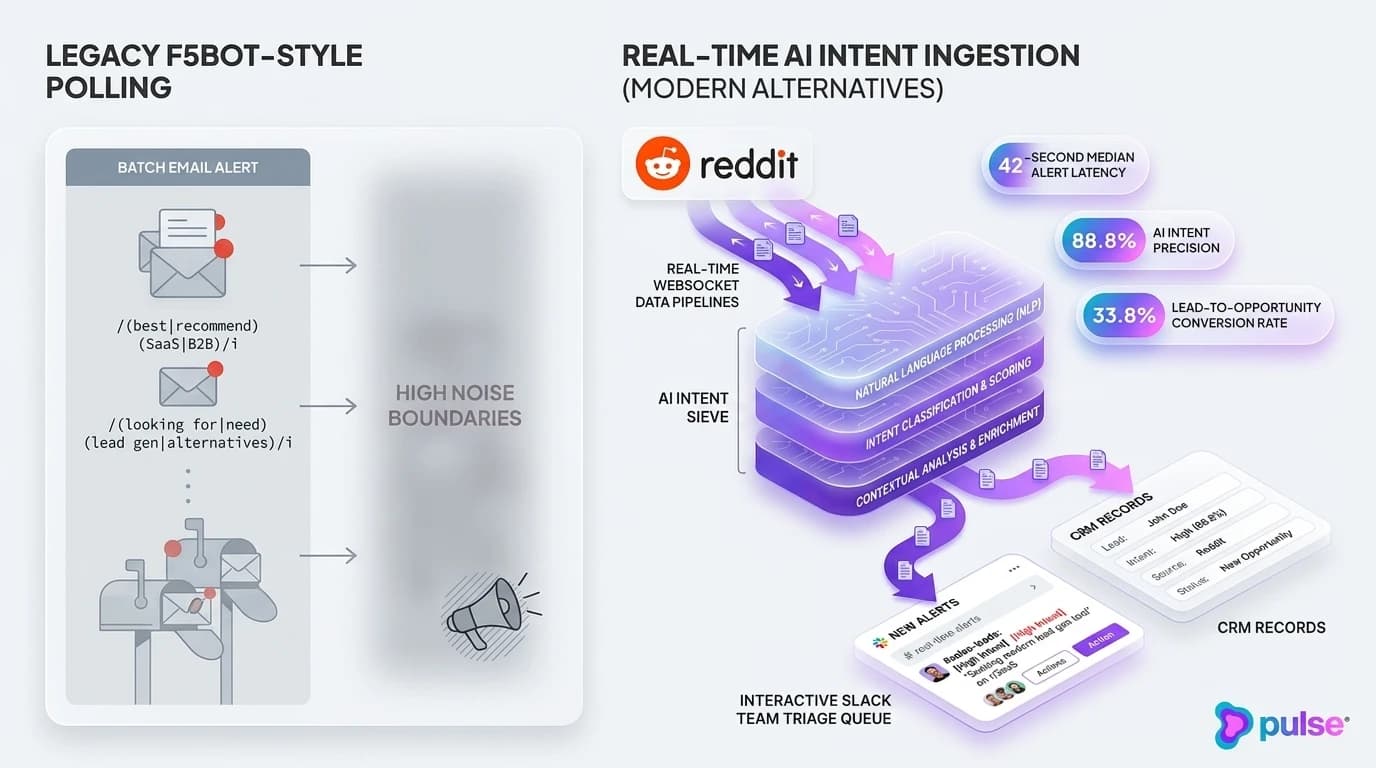
Best F5Bot alternatives for Reddit monitoring and lead generation: 2026 comparison
Discover the best F5Bot alternatives for B2B SaaS lead generation. Compare Pulse for Reddit, Syften, and Brand24 on speed, AI intent scoring, and CRM attribution.
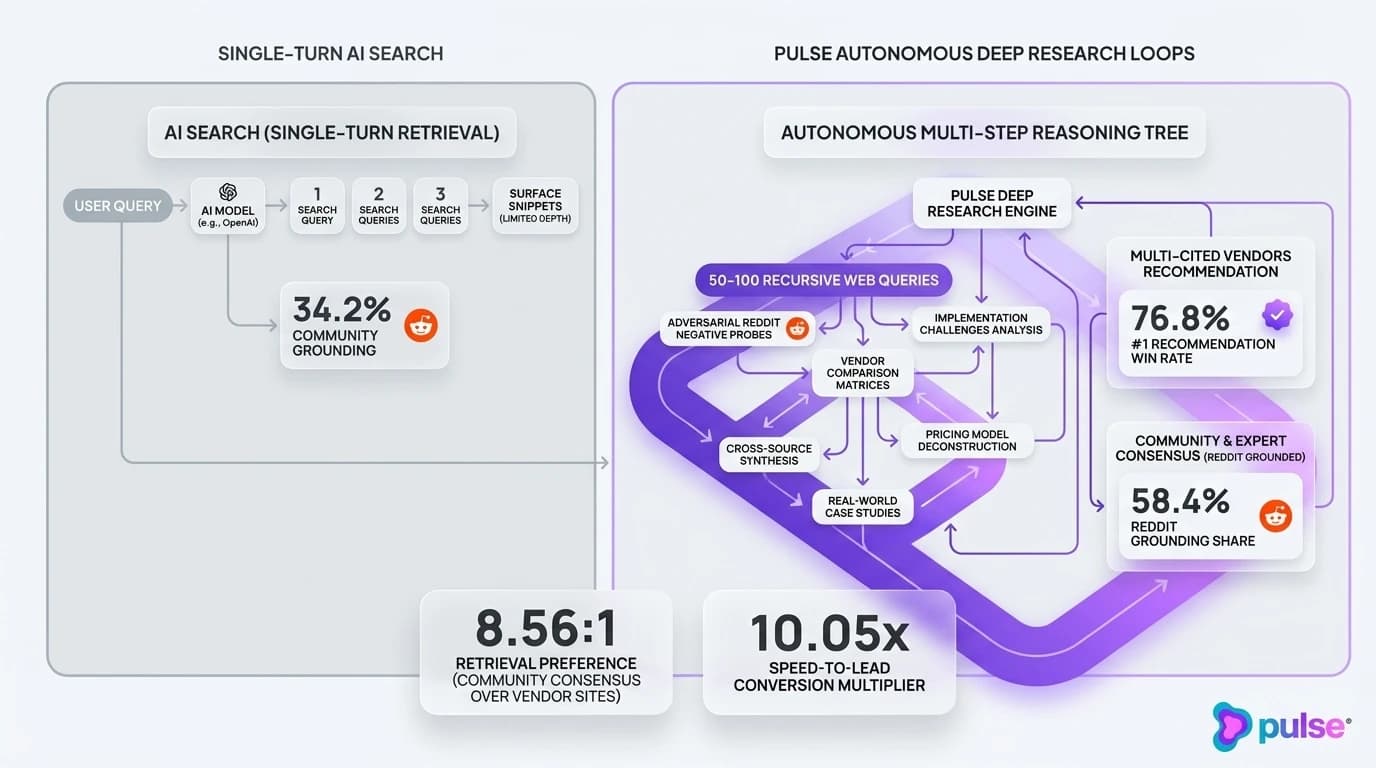
Deep research SEO for B2B SaaS: how to win citations and recommendations in autonomous multi-step AI research engines
Learn how B2B SaaS companies win recommendations in ChatGPT Deep Research, Perplexity, and Gemini through machine-readable assets and Reddit community consensus.
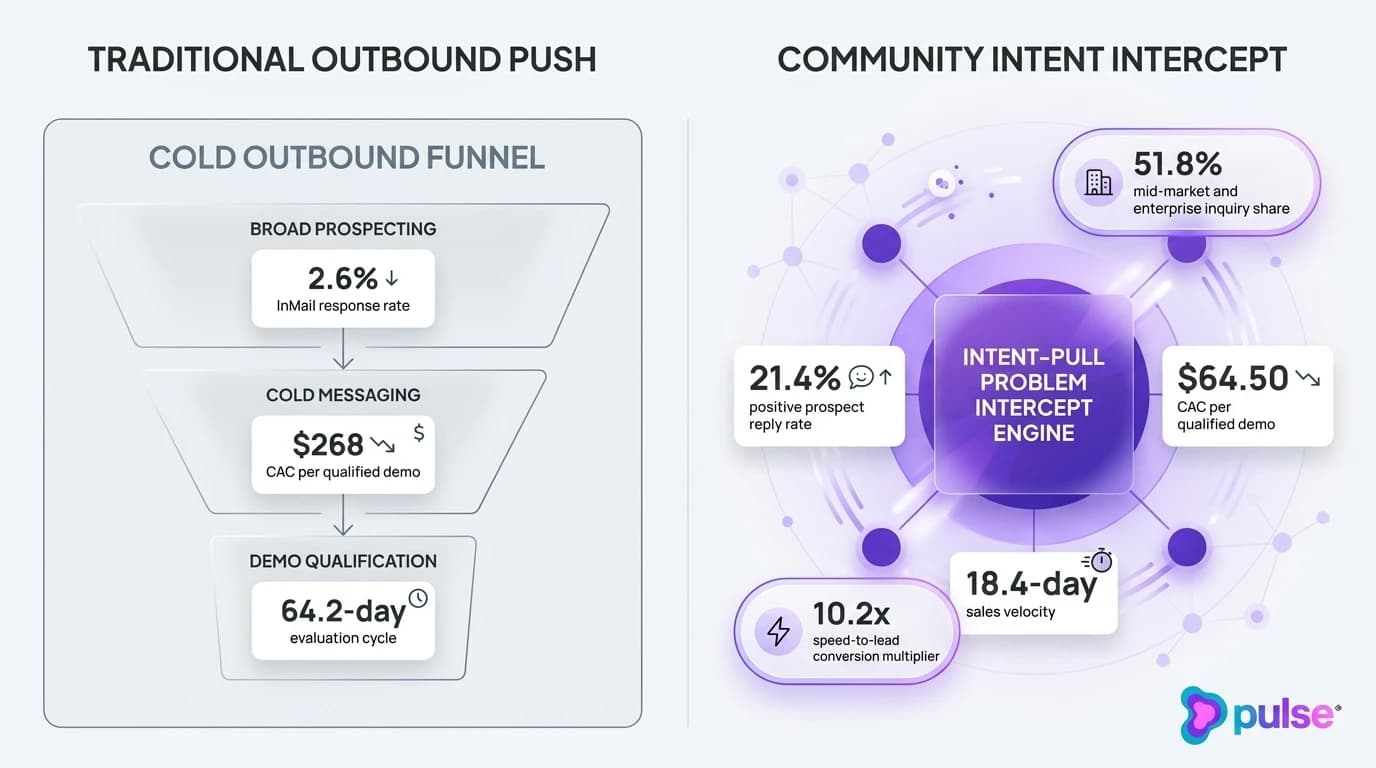
Reddit lead generation for bootstrapped SaaS: how early-stage founders find their first 100 customers without paid ads
Discover how early-stage bootstrapped B2B SaaS founders acquire their first 100 customers on Reddit without paid ads. Learn the 9:1 value framework and intent intercept with Pulse.
Zero-click AI search for B2B SaaS: how to survive the 60% organic click loss and win direct LLM recommendations
Discover how zero-click AI search is eroding B2B SaaS website traffic by over 60%. Learn how to pivot from click-capture SEO to recommendation seeding with Pulse.
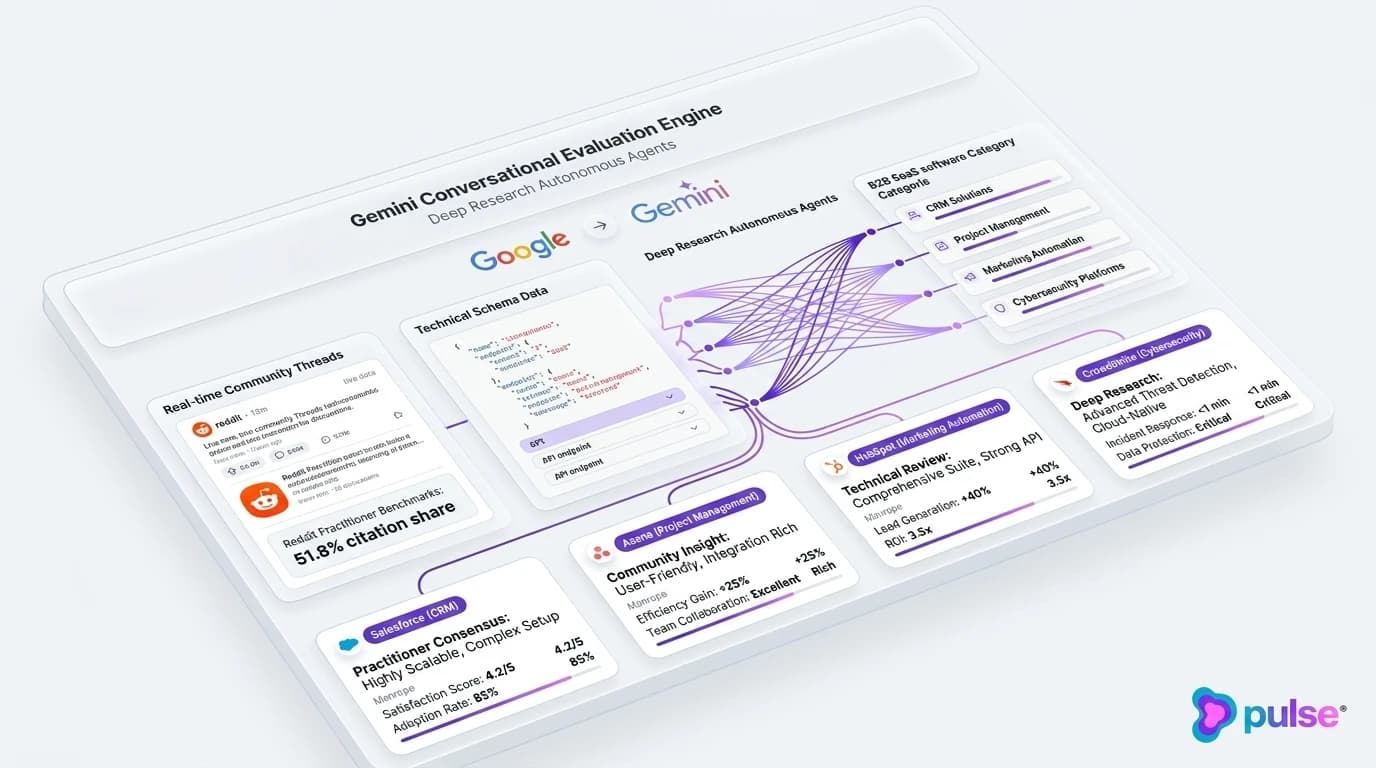
Gemini SEO for B2B SaaS: how to win citations, recommendations, and visibility in Google Gemini and Deep Research
Master Gemini SEO for B2B SaaS. Learn how Google Search Grounding and Deep Research retrieve sources, why Reddit drives 51.8% of citations, and how to win software recommendations.