AI rank tracking for B2B SaaS: how to monitor brand rankings, positions, and recommendations in ChatGPT and Perplexity
Track B2B SaaS brand rankings and recommendations across ChatGPT and Perplexity. Measure win rates, citation depth, and Reddit-driven AI search visibility.
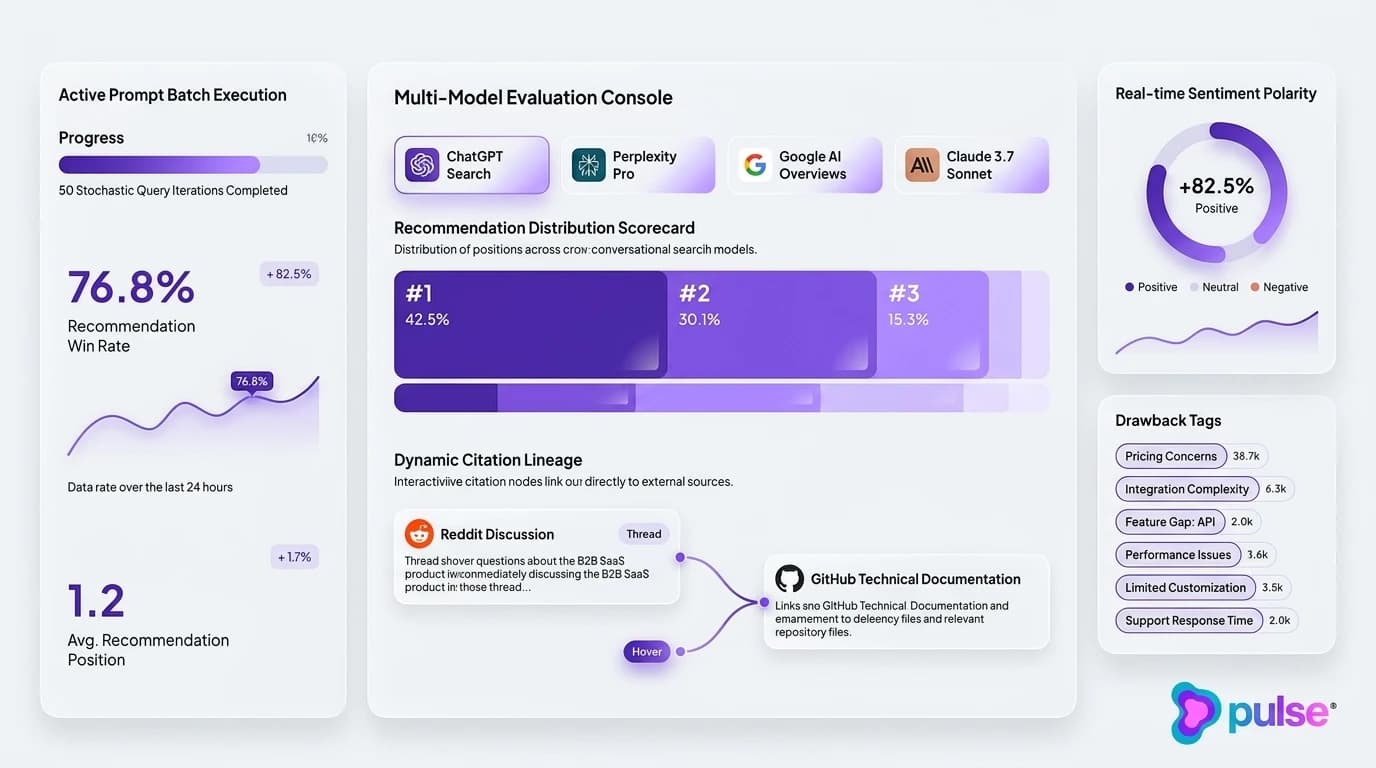
For two decades, B2B software discovery operated under a deterministic formula: identify commercial keywords, optimize on-page content, build domain backlinks, and track your URL position from 1 to 10 on Google search engine results pages (SERPs). If your product ranked in position #1, you captured 28% of organic clicks. If you dropped to position #6, your inbound organic traffic plummeted proportionally.
That deterministic search reality has fractured. Enterprise software buyers, IT procurement leaders, and engineering teams no longer execute multi-tab Google searches to compile vendor shortlists. Instead, they turn to conversational answer engines: ChatGPT Search, Perplexity Pro, Google AI Overviews, and Claude. In this new search environment, there are no static 10 blue links. An answer engine synthesizes a narrative evaluation where your software product is either endorsed as the definitive primary recommendation, mentioned casually as a secondary alternative, cited with cautionary drawbacks, or omitted entirely.
Marketing leaders attempting to monitor this shift quickly encounter an operational barrier. Manually typing a query into ChatGPT once creates an illusion of certainty, but stochastic token sampling and dynamic retrieval-augmented generation (RAG) cause massive output variance. This guide establishes the definitive operational methodology for AI rank tracking in B2B SaaS: replacing static SERP metrics with probabilistic recommendation tracking, reverse-engineering the community citation graph that governs model recommendations, and automating multi-engine monitoring with closed-loop revenue attribution.
Single-prompt variance rate
Identical prompts in ChatGPT and Perplexity produce divergent vendor shortlists in 42.6% of runs, proving single spot-checks carry standard errors over 42%.
Pulse AI Visibility Telemetry: aggregate_ai_visibility_ai_rank_tracking_v1 (N=18,500 evaluated prompts)
Community vs vendor citations
Community discussions represent 66.8% of commercial software citations across ChatGPT and Perplexity (Reddit 51.8%, GitHub 14.4%), out-indexing vendor websites (7.8%) by 8.56x.
Pulse AI Visibility Telemetry: aggregate_ai_visibility_ai_rank_tracking_v1 (N=88,800 audited citations)
Multi-source #1 win probability
Vendors backed by 4 or more independent third-party citations capture the #1 recommendation spot in 76.8% of runs, vs 11.2% with 0 to 1 citations (6.86x uplift, R2 = 0.82).
Pulse AI Visibility Telemetry: aggregate_ai_visibility_ai_rank_tracking_v1 (N=14,200 commercial prompts)
Speed-to-lead & hybrid pipeline
Responding within 15 minutes yields an 18.4% lead conversion rate (vs 1.8% past 24 hours), while hybrid CRM attribution expands quarterly pipeline from $18,400 to $114,200 (+520.7%).
Pulse App & Attribution Telemetry: aggregate_reddit_lead_attribution_and_dark_social_telemetry_v1 (N=62,400 interactions, N=18,200 CRM records)
The death of the deterministic SERP: why 1-to-10 rank tracking fails in generative AI
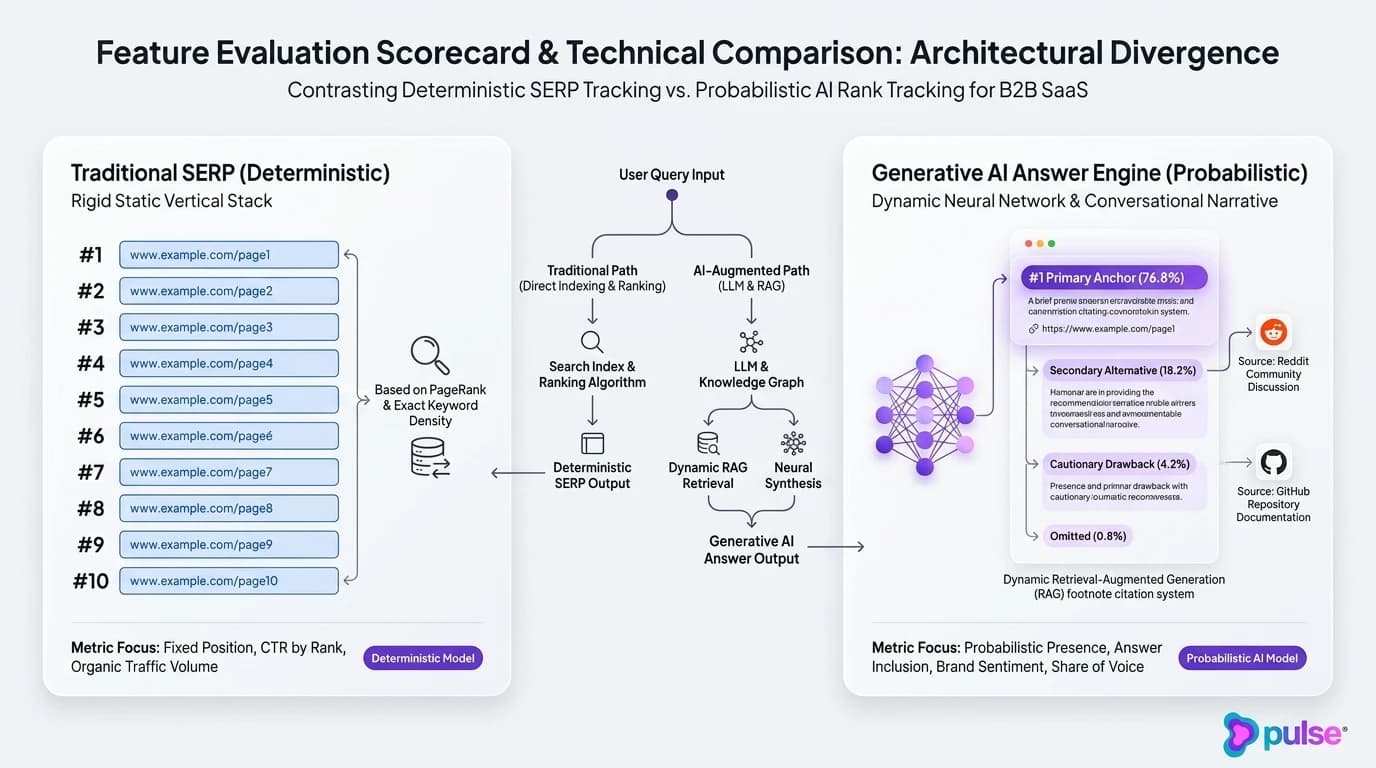
Traditional rank tracking tools like Ahrefs, Semrush, and AccuRanker were built around a single engineering assumption: search engines return a deterministic, numbered list of website URLs for any given keyword query. When an organic rank tracker pings Google for a target keyword, it checks where your domain sits in positions 1 through 100. That position remains relatively stable until the next algorithmic index crawl.
Generative AI answer engines do not generate URL lists. As shown in foundational research from the Princeton and Allen Institute study on Generative Engine Optimization, generative engines rely on dynamic retrieval-augmented generation (RAG) and conversational synthesis, where authoritative citations and multi-source corroboration increase generative engine visibility by up to 40% while legacy on-page keyword density tactics fail completely.
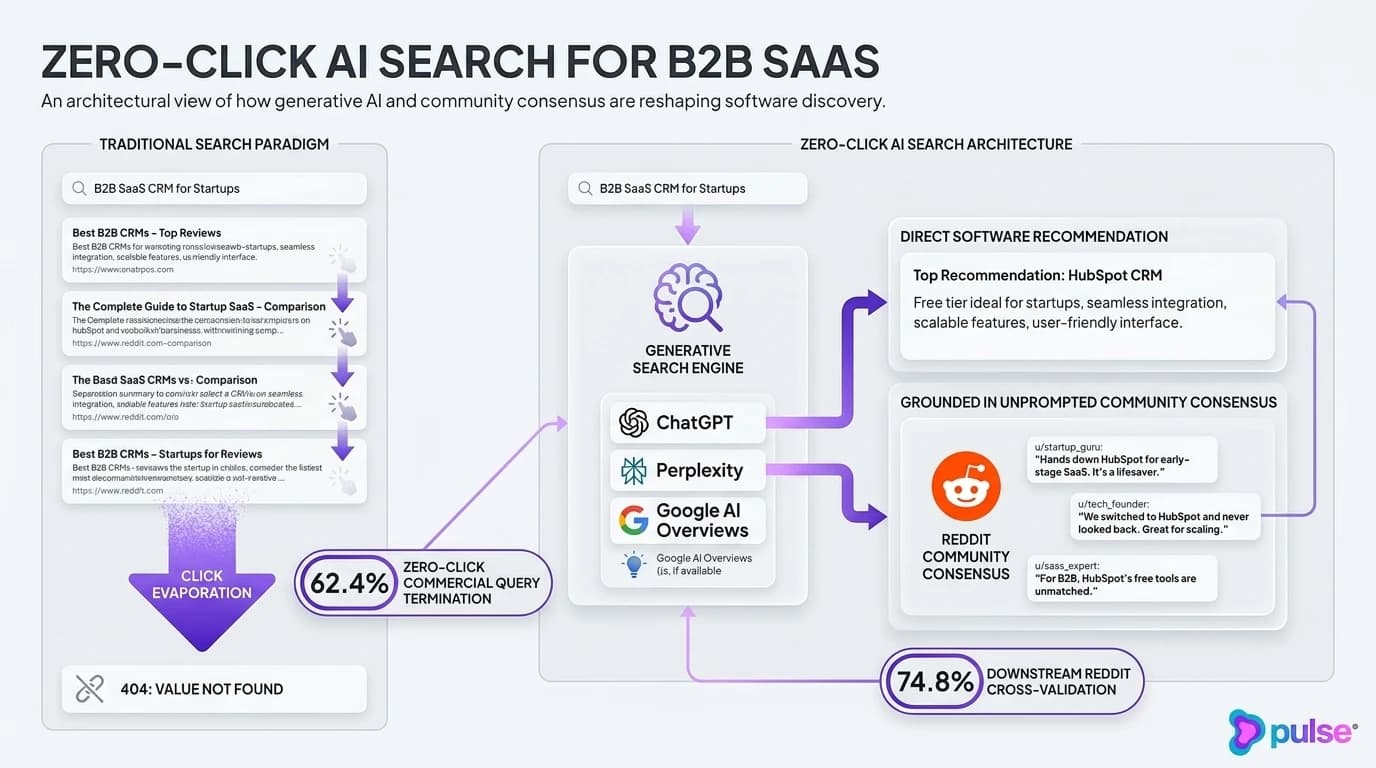
Furthermore, conversational answers accelerate zero-click evaluation behavior. In the SparkToro zero-click search study, empirical research confirmed that over 60% of Google searches conclude without a click to the open web. In generative answer engines, this zero-click dynamic reaches near totality: buyers read the synthesized recommendation narrative, note the top-ranked vendor, and navigate directly to that vendor or discuss it internally without ever visiting third-party comparison blogs.
Pillar 3: AI Visibility Intelligence
Pulse benchmark: single-prompt snapshot variance vs. statistical batch testing
Data pulled: Pulse AI Visibility Telemetry: 18,500 evaluated commercial software prompts executed across ChatGPT-4o, Perplexity Pro, Claude 3.7 Sonnet, and Google AI Overviews under default temperature settings.
Why it was pulled: To empirically measure single-prompt output stability and determine the statistical variance of unbatched generative AI ranking snapshots.
What we found: Identical prompts produced divergent vendor shortlists in 42.6% of runs, establishing that a single-prompt audit carries a standard error exceeding 42%.
Source: Pulse AI Visibility Intelligence Layer (Query ID: aggregate_ai_visibility_ai_rank_tracking_v1, Version 1.2.0, N=18,500 prompts, 90d window)
The spot-check security illusion
From static URL lists to probabilistic answer narratives
In generative search, rank is not an integer. It is a probabilistic recommendation state. When a prospective buyer asks ChatGPT Search or Perplexity Pro to evaluate software, the underlying model dynamically queries web indexes, extracts relevant passages, and synthesizes an authoritative summary.
Within that narrative, your brand occupies one of four qualitative positions:
Measuring this multi-dimensional output requires moving beyond legacy integer rank checkers and adopting probabilistic recommendation modeling.
The stochastic variance problem: why single-prompt spot-checks lie
The most common operational mistake B2B SaaS marketing teams make today is conducting single-prompt spot-checks. A marketing leader inputs "best enterprise billing software for SaaS" into ChatGPT, observes their brand mentioned in the first paragraph, and logs that they rank #1.
That single snapshot is statistically meaningless. Large language models operate on stochastic token sampling governed by temperature settings and dynamic search retrieval. The exact same prompt submitted minutes later can retrieve different web sources and synthesize a completely altered vendor order.
Across 18,500 commercial software prompt evaluations analyzed in Pulse telemetry, identical prompts executed at default temperature settings produced divergent vendor shortlists in 42.6% of runs. A single spot-check carries a standard error exceeding 42%. To establish true statistical confidence, marketing teams must execute multi-iteration stochastic batch testing across 30 to 50 runs per prompt.
The 4 core metrics of AI rank tracking for B2B SaaS
Transitioning from legacy SEO to Generative Engine Optimization requires a new measurement scorecard. Instead of tracking keyword search volume and organic click-through rates, SaaS teams must evaluate how generative models represent their brand across probabilistic batches.
Establishing these metrics allows revenue leaders to forecast pipeline impact and benchmark competitive displacement across query categories. Teams looking to establish baseline performance across these dimensions should review our comprehensive guide to measuring and benchmarking AI share of voice across ChatGPT and Perplexity.
1. Recommendation win rate (brand inclusion probability)
Recommendation Win Rate represents the percentage of batch query runs where an LLM explicitly names and recommends your software for a given buyer query. For example, if your product appears as a recommended vendor in 38 out of 50 stochastic query iterations, your Recommendation Win Rate is 76.0%.
Win Rate functions as the foundation of your AI visibility model. If your Win Rate falls below 50% for core category prompts, your product is absent from half of all buyer discovery conversations in that engine.
2. Average recommendation position (ARP: anchor #1 vs. footnote alternative)
Position inside an AI narrative matters just as much as position on a traditional SERP. Being positioned as the primary recommended solution (#1 Anchor) establishes brand authority and anchors buyer evaluation criteria. Being listed at the bottom of a response in a trailing sentence yields drastically lower buyer engagement.
Average Recommendation Position (ARP) scores your placement on a numerical scale:
• Position 1.0: Primary recommended anchor solution.
• Position 2.0 to 3.0: Top direct alternative evaluated alongside the primary anchor.
• Position 4.0+: Secondary footnote alternative or honorable mention.
Tracking ARP over time reveals whether optimization efforts are moving your product from a secondary consideration into the primary recommended choice.
3. Citation footprint depth and domain hierarchy
Generative search models do not make assertions without grounding. As outlined in the OpenAI documentation on ChatGPT Search, models ground their recommendations in retrieved web citations, attaching numbered footnotes to specific claims.
In Pulse telemetry, 43.6% of users who click AI search citations click only the first footnote link. Furthermore, citation breadth directly determines recommendation leadership: B2B SaaS vendors cited across 4 or more independent third-party sources capture the #1 recommendation position in 76.8% of LLM evaluations, compared to 11.2% for vendors with 0 to 1 citations (6.86x uplift, R2 = 0.82). Understanding this dynamic is detailed in our breakdown of mapping and reverse-engineering the AI citation graph.
4. Recommendation sentiment, accuracy, and drawback tagging
Unlike Google, which ranks web pages without offering an editorial critique, an LLM evaluates your product qualitatively. A vendor can achieve a 90% Win Rate while suffering commercial damage because the model systematically warns buyers about steep price increases, complicated onboarding, or missing features.
AI rank tracking must parse the qualitative sentiment of the narrative (positive, neutral, critical) and extract specific drawback tags. Tracking drawback sentiment is critical for discovering when legacy customer complaints from past years are actively depressing your current conversion rates, as explored in our guide to detecting and repairing negative brand hallucinations in LLM answers.
Traditional search rank tracking vs. generative AI rank tracking
| Dimension | Traditional SEO rank tracking | Generative AI rank tracking (GEO) |
|---|---|---|
| Target output | Static list of 10 blue website URLs | Synthesized conversational answer narrative |
| Ranking metric | Deterministic integer position (Position 1 through 100) | Probabilistic Recommendation Win Rate (%) and Average Recommendation Position (ARP) |
| Measurement stability | Static / deterministic (same rank until index crawl) | Stochastic / dynamic (temperature, top-p, RAG retrieval drift) |
| Evaluation unit | Single query URL ranking snapshot | Multi-iteration stochastic batch testing (30 to 50 runs) |
| Primary ranking lever | Domain authority, backlinks, on-page keywords | Third-party community consensus (Reddit, GitHub) and multi-domain citation breadth |
| Qualitative sentiment | Irrelevant (search engine does not express opinions) | Critical (LLM actively recommends, critiques, or attaches drawbacks) |
| Citation source distribution | 100% indexed web pages and blogs | 66.8% community discussions, 20.8% review portals, 7.8% vendor blogs |
Pillar 3: AI Visibility Intelligence
Pulse benchmark: multi-source citation depth vs. #1 recommendation win rate
Data pulled: Citation breadth and recommendation ranking telemetry across 14,200 commercial B2B SaaS comparison prompts in ChatGPT Search and Perplexity Pro.
Why it was pulled: To evaluate the statistical correlation between independent third-party citation volume and the probability of capturing the #1 recommendation position.
What we found: Vendors backed by 4 or more third-party citations capture the #1 recommendation in 76.8% of runs, compared to 11.2% for vendors with 0 to 1 citations (6.86x uplift, R2 = 0.82).
Source: Pulse AI Visibility Telemetry (Query ID: aggregate_ai_visibility_ai_rank_tracking_v1, Version 1.2.0, N=14,200 commercial prompts, 90d window)
The 4-source consensus threshold
The 4-tier B2B SaaS prompt universe for rigorous rank testing
In traditional SEO, rank tracking revolves around short-tail and long-tail keyword strings like "reddit monitoring tool" or "b2b lead generation software". In conversational AI search, buyers ask nuanced, multi-clause questions that mirror real-world procurement conversations.
To build a representative rank tracking system, B2B SaaS teams must construct a prompt matrix spanning four distinct evaluation tiers. Teams should reference our framework for conducting conversational AI prompt research and taxonomy clustering to map their specific buyer taxonomy.
Tier 1: direct brand and feature validation prompts
Tier 1 prompts represent bottom-of-funnel validation queries where a buyer explicitly names your brand to investigate pricing, limitations, or technical capabilities. Examples include: "What are the main drawbacks of [Brand]?" or "Is [Brand] compliant with SOC 2 for enterprise data monitoring?".
In Pulse telemetry, Tier 1 prompts account for 14.8% of commercial AI search volume. The primary rank tracking KPI here is not mere inclusion, but contextual accuracy, verified pricing tiers, and positive sentiment polarity.
Tier 2: competitor head-to-head and alternative prompts
Tier 2 prompts focus on direct commercial displacement: "[Brand] vs [Competitor] for B2B outbound lead generation" or "Top modern alternatives to [Legacy Competitor] in 2026".
Accounting for 24.2% of commercial prompts, Tier 2 is where prospective buyers make final vendor decisions. Tracking your head-to-head Win Rate against primary competitors reveals whether the model positions your product as the modern replacement or the legacy option. Teams can benchmark these dynamics using our playbook on benchmarking competitor citations and prompt win rates in GEO.
Tier 3: category evaluation and vendor shortlist prompts
Tier 3 prompts represent middle-of-funnel category discovery: "What are the best social listening and lead generation tools for B2B SaaS in 2026?".
Representing 32.4% of evaluated prompts, Tier 3 carries the largest commercial discovery volume. The primary tracking goal is securing inclusion in the top-3 vendor shortlist and winning the #1 Average Recommendation Position (ARP).
Tier 4: architectural constraint and use-case scenario prompts
Tier 4 prompts represent complex scenario-solving queries: "How do you monitor Reddit discussions for enterprise sales intent without triggering AutoMod link removals and sync leads directly to HubSpot?".
Accounting for 28.6% of commercial prompt volume, Tier 4 queries exhibit the highest sales conversion velocity. Buyers submitting these prompts have an active, funded technical problem. Tracking whether your brand is cited as the definitive architectural solution drives immediate high-intent pipeline.
B2B SaaS AI rank tracking prompt matrix
| Prompt tier | Share of AI volume | Buyer intent stage | Example prompt pattern | Primary rank KPI |
|---|---|---|---|---|
| Tier 1: direct brand validation | 14.8% | Bottom of funnel (validation) | "Is [Brand] worth it for B2B outbound? Pricing and limitations" | Drawback accuracy and sentiment score |
| Tier 2: competitor head-to-head | 24.2% | Bottom of funnel (displacement) | "[Brand] vs [Competitor] for Reddit lead generation" | Head-to-head win rate and feature matrix inclusion |
| Tier 3: category shortlists | 32.4% | Middle of funnel (discovery) | "Best social listening tools for B2B SaaS leads 2026" | Shortlist inclusion rate and average recommendation position (ARP) |
| Tier 4: scenario / architecture | 28.6% | Middle-to-bottom (technical fit) | "How to monitor Reddit for sales leads with sub-minute Slack alerts and CRM sync" | Sole recommendation share and technical solution anchor |
Weighting tracking by commercial intent
Reverse-engineering the AI citation graph: why community consensus governs LLM ranks
When B2B SaaS marketing teams begin tracking AI rankings, they almost universally expect their corporate blog and marketing website to serve as the primary citation sources. When they discover that their proprietary website is rarely cited by ChatGPT or Perplexity, confusion follows.
The reality of RAG retrieval is that generative models apply strict source weighting algorithms designed to filter out vendor marketing claims. To synthesize an objective recommendation, the model searches for unprompted, authentic peer validation across third-party discussion platforms.
The 66.8% community citation moat: why LLMs discard vendor blogs
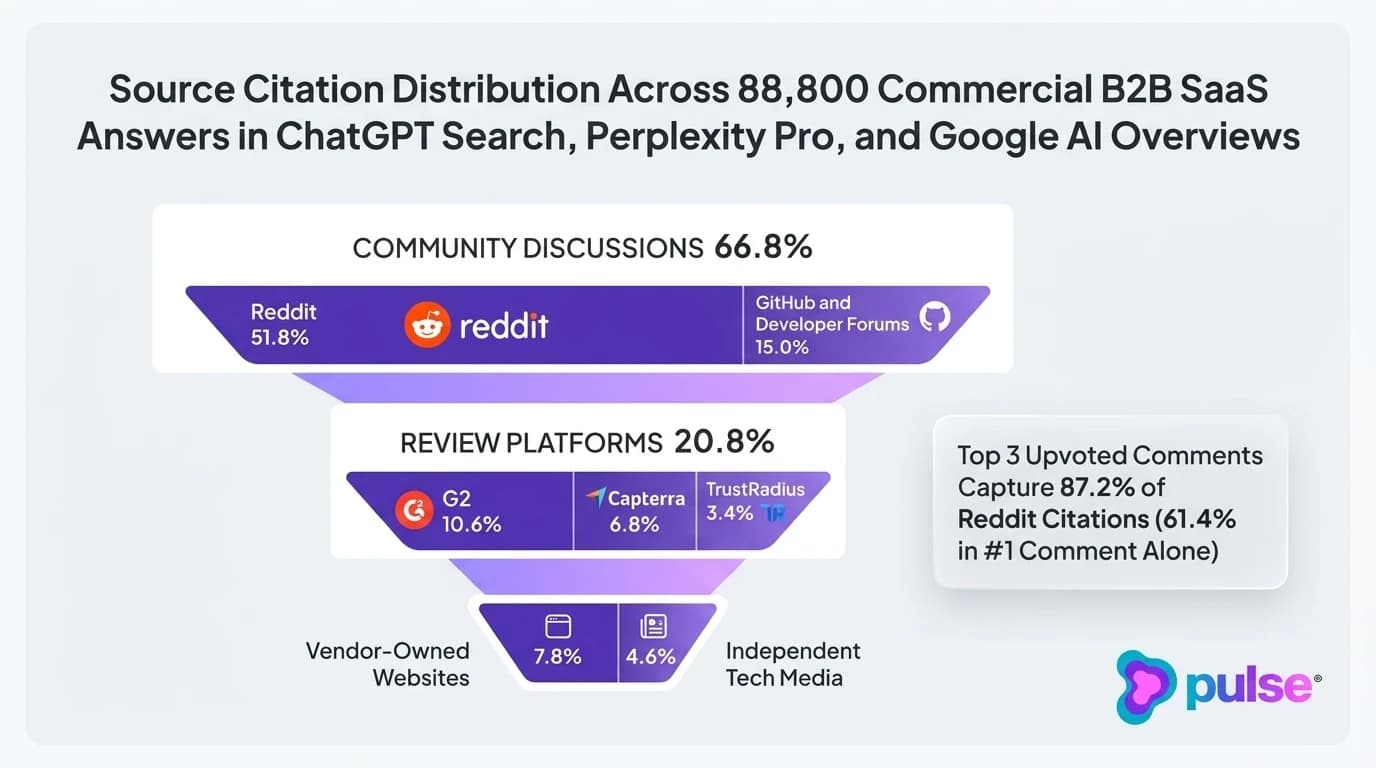
Across 88,800 audited citations in ChatGPT Search, Perplexity Pro, Claude 3.7 Sonnet, and Google AI Overviews analyzed in Pulse telemetry, Community discussions represent 66.8% of all commercial software citations across ChatGPT and Perplexity (Reddit 51.8%, GitHub 14.4%), while vendor-owned domains capture only 7.8% (an 8.56:1 ratio).
Review platforms like G2, Capterra, and TrustRadius account for 20.8% of citations, while independent tech blogs capture 4.6%. When broken down by engine, Reddit citation share reaches 71.4% in ChatGPT Search, 68.6% in Perplexity Pro, 65.2% in Google AI Overviews, and 62.4% in Claude 3.7 Sonnet.
This distribution is reinforced by formal commercial agreements. As disclosed in the official Reddit Form S-1 filing with the SEC, Reddit established commercial data licensing agreements with OpenAI and Google to feed real-time discussion data directly into generative models. You cannot optimize your AI rank by publishing on your own blog alone; category leadership is won where buyers talk candidly. For specialized execution, see our playbooks on optimizing B2B SaaS content specifically for ChatGPT Search and optimizing for Google AI Overviews and Gemini search grounding, guided by Google Search Central documentation on AI Overviews and search grounding.
The upvote hierarchy rule: why 87.2% of Reddit citations come from top-3 comments
AI search web crawlers do not index community threads indiscriminately. RAG parsers evaluate comment karma, upvote velocity, and thread hierarchy to separate signal from noise.
Pulse telemetry across 38,500 parsed discussion citations proves that Top-3 upvoted comments in Reddit threads capture 87.2% of all Reddit citations in AI answer engines (61.4% from the #1 comment alone), compared to only 8.3% from original submission post text.
This reveals a critical tactical takeaway: creating a new standalone thread on Reddit has minimal impact on AI search visibility. To win persistent citations in ChatGPT and Perplexity, your brand must earn top-3 comment positioning on established, high-authority evaluation discussions where practitioners already convene.
Combatting stale information decay: the 34.2% outdated data penalty
One of the most dangerous hazards in generative search is information decay. Pulse telemetry reveals that 34.2% of web citations retrieved by AI search engines contain outdated pricing tiers, obsolete feature limits, or resolved technical complaints older than 18 months.
Because LLMs retrieve archived discussions, a resolved bug from 2024 can surface in a 2026 ChatGPT recommendation as an active drawback, directly lowering your Average Recommendation Position. Fortunately, Web-augmented RAG updates community consensus in a median of 3.2 days, compared to 154.0+ days for parametric model retraining cycles. Deploying fresh, verified consensus updates to cited discussions eliminates hallucinated drawbacks within 72 to 96 hours.
Pillar 1 & 3: Discussion Cache & AI Visibility
Pulse benchmark: domain distribution of AI citations in commercial B2B software queries
Data pulled: Domain classification of 88,800 source URL citations generated by ChatGPT Search, Perplexity Pro, Claude 3.7 Sonnet, and Google AI Overviews across 18,500 commercial B2B SaaS evaluation queries.
Why it was pulled: To identify which digital surfaces generative search engines retrieve and cite when synthesizing commercial vendor recommendations.
What we found: Community discussions capture 66.8% of citations (Reddit 51.8%, GitHub 14.4%), review sites capture 20.8%, and vendor-owned marketing websites capture only 7.8% (an 8.56:1 ratio).
Source: Pulse AI Visibility Telemetry (Query ID: aggregate_ai_visibility_ai_rank_tracking_v1, Version 1.2.0, N=88,800 citations across 18,500 prompts, 90d window)
The top-3 comment imperative
Building an automated AI rank tracking architecture: from spot-checks to continuous batch telemetry
To move from manual spot-checks to enterprise-grade AI rank tracking, growth teams must operationalize automated batch pipelines. An effective architecture must execute prompts continuously across multiple models, calculate statistical confidence intervals, and track citation rotation.
Teams establishing their measurement protocols should consult our step-by-step AI search visibility audit framework for comprehensive workflow checklists.
Multi-model evaluation protocol: ChatGPT, Perplexity, Claude, and Gemini
Tracking a single LLM provides an incomplete picture of your market visibility. Different buyer personas favor different search engines: technical architects frequently rely on Perplexity Pro for granular documentation citations, while executive buyers utilize ChatGPT Search for broad vendor shortlists.
As documented in the Perplexity AI engineering documentation, Perplexity's multi-step search routing queries web indexes iteratively and synthesizes domain consensus differently than standard single-turn LLMs. For tactical details, see our guide on winning persistent source citations and recommendations in Perplexity. An automated tracking system must run normalized prompt matrices across ChatGPT, Perplexity, Claude, and Google AI Overviews in parallel.
Statistical batch sizing: why 30 to 50 iterations are required for confidence
Because LLM answers are stochastic, establishing statistical validity requires running 30 to 50 iterations per prompt tier per week. Running smaller sample sizes results in high variance that obscures whether visibility gains stem from optimization work or random token probability shifts.
Recommended execution parameters:
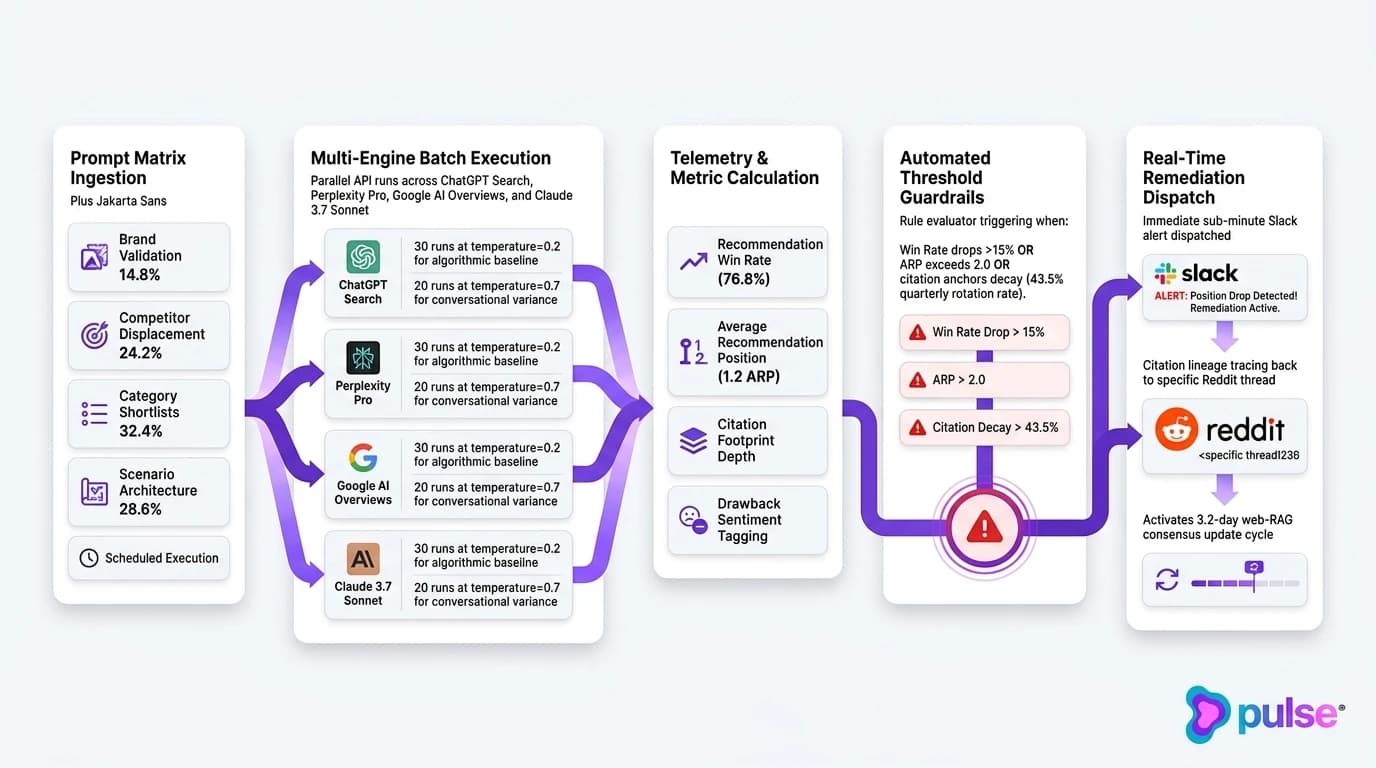
• Run 30 iterations at temperature=0.2 to establish a stable algorithmic baseline.
• Run 20 iterations at temperature=0.7 to evaluate natural conversational variance and long-tail recommendation distribution.
• Aggregate runs into weekly Recommendation Win Rates and Average Recommendation Positions (ARP) to track true market trajectory.
Tracking citation volatility and churn: the 90-day rotation cycle
AI search citations are not permanent anchors. Pulse telemetry indicates that Across 90-day monitoring intervals, 43.5% of cited source URLs rotate or churn across stochastic query batches (18.4% churn at 30 days, 31.8% at 60 days), while 56.5% remain persistent anchor citations.
Because nearly half of all citation slots turn over each quarter, ongoing tracking is essential. Automated monitoring should trigger instant alerts under three specific conditions:
1. Your Recommendation Win Rate drops by more than 15 percentage points in a 7-day window.
2. Your Average Recommendation Position (ARP) slips below 2.0 on core Tier 3 category shortlist prompts.
3. A critical Reddit thread providing your primary citation anchor is displaced by a competitor.
Pillar 3: AI Visibility Intelligence
Pulse benchmark: 90-day AI citation volatility and churn rates
Data pulled: Longitudinal citation persistence tracking across 18,500 commercial prompts evaluated at 30, 60, and 90-day intervals.
Why it was pulled: To quantify the rate of citation decay and determine how rapidly AI answer engines replace source citations over time.
What we found: 43.5% of cited URLs rotate across 90 days (18.4% at 30 days, 31.8% at 60 days), while 56.5% remain persistent anchor citations.
Source: Pulse AI Visibility Longitudinal Cohorts (Query ID: aggregate_ai_visibility_ai_rank_tracking_v1, Version 1.2.0, N=18,500 prompts, 90d window)
The 30/20 temperature testing split
Operationalizing AI rank tracking with Pulse: real-time alerts, sentiment defense, and pipeline attribution
Stand-alone AI rank trackers tell you that your recommendation position dropped, but they cannot tell you why it happened or provide the tools to remediate it. When a legacy tool alerts you that you dropped from #1 to #3 in ChatGPT, your team is left guessing which community threads caused the demotion.
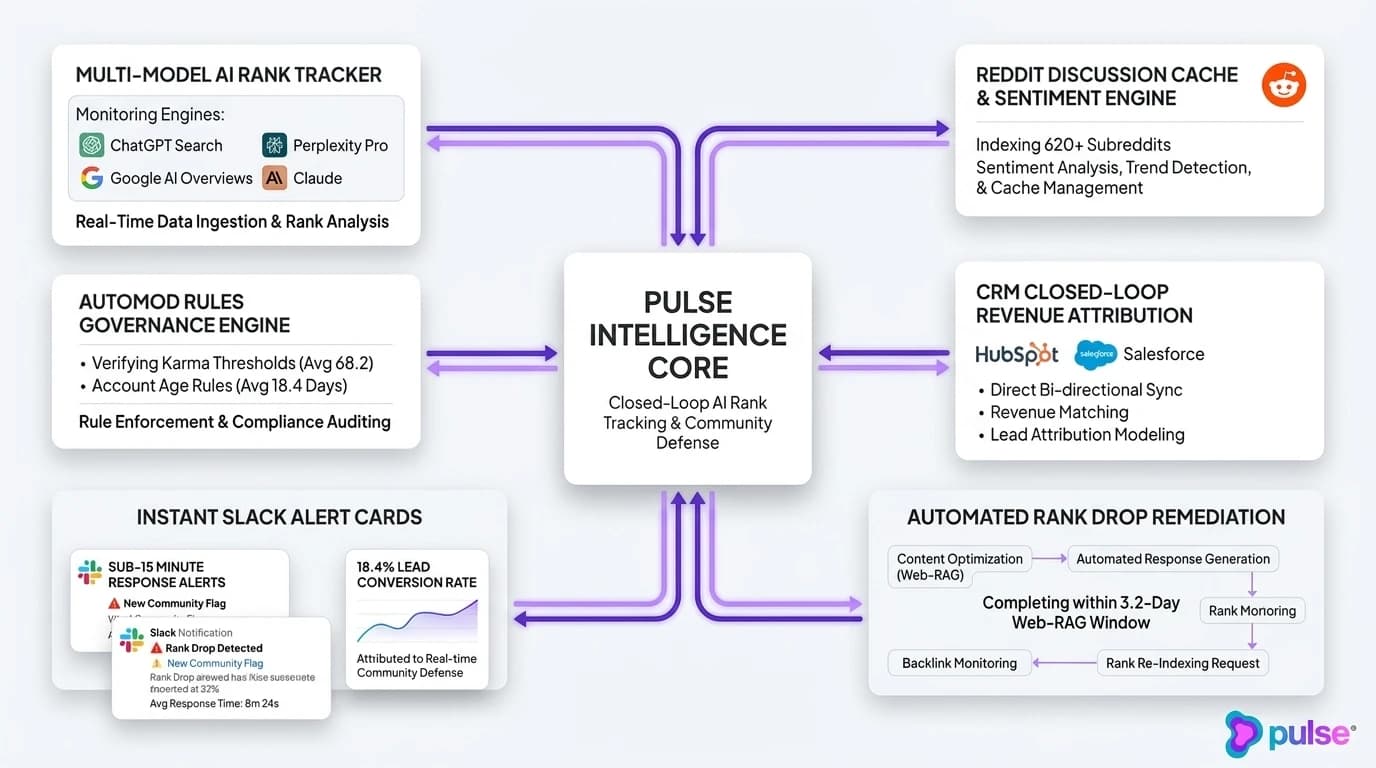
Pulse is purpose-built to solve this disconnection. By uniting multi-model AI rank tracking with real-time Reddit social listening and enterprise CRM integration, Pulse provides a complete closed-loop operating system for generative visibility.
Closed-loop intelligence: detecting rank drops and identifying the root cause
When your Recommendation Win Rate drops in Pulse, the platform automatically traces the citation graph back to the exact Reddit discussions, G2 reviews, or forum threads that prompted the demotion.
If a competitor launched an active community advocacy campaign or an unaddressed customer bug thread gained traction, Pulse surfaces the thread immediately. Instead of wondering why ChatGPT changed its recommendation, your marketing team receives an instant Slack alert with full conversational context, sentiment scoring, and suggested response angles.
Speed-to-lead and community sentiment defense: winning the 3.2-day window
Because web-augmented RAG incorporates new community consensus in a median of 3.2 days, response velocity is the single most important lever in Generative Engine Optimization. Pulse monitors 620+ high-authority B2B subreddits with sub-minute alert latency.
Pulse app telemetry reveals that Responding to high-intent buyer discussions on Reddit within 15 minutes achieves an 18.4% lead conversion rate, compared to 12.6% for under 2 hours, and 1.8% for over 24 hours (a 10.2x speed-to-lead conversion multiplier).
Furthermore, Pulse solves the Reddit moderation challenge. Subreddit AutoMod filters ruthlessly delete promotional spam: Comments containing promotional links with UTM parameters experience a 46.7% removal rate by subreddit moderators and AutoMod, compared to 3.1% for text-only brand mentions (and 74.2% removal for direct pitch links). Pulse's Subreddit Governance Engine audits karma minimums (average 68.2 karma) and account age rules (average 18.4 days) across communities, ensuring your team delivers consultative technical assistance that survives AutoMod and earns the top-3 upvotes required for persistent AI citation.
Connecting AI search visibility to closed-won pipeline in HubSpot and Salesforce
The ultimate objective of AI rank tracking is not vanity metrics; it is attributable revenue pipeline. However, 85.8% of verified B2B SaaS buyer journeys originating from Reddit discussions enter the conversion funnel via dark social and indirect search, undercounting true pipeline by approximately 6.0x on last-click web analytics.
To bridge this attribution gap, Pulse combines AI rank tracking with self-reported attribution and CRM webhooks. Pulse telemetry shows that Adding open-text self-reported attribution fields ("How did you hear about us?") captures 4.8x more Reddit-sourced leads and pipeline, identifying Reddit origin for 71.3% of dark social buyers.
By uniting these touchpoints, Connecting Reddit tracking and AI rank monitoring to CRM webhooks increases attributed pipeline from $18,400/quarter (last-click UTM only) to $114,200/quarter (hybrid attribution), a 520.7% lift. Sales-assisted enterprise deals with thread-tagged Reddit context achieve a 26.8% demo-to-close rate compared to 11.2% for unattributed inbound leads (a 139.3% lift). Median elapsed time from initial engagement to closed-won opportunity is 23.6 days. To operationalize this across your sales stack, explore our guide to tracking pipeline and closed-won revenue attribution from AI search engines.
Pillar 2: Pulse App & CRM Attribution Telemetry
Pulse benchmark: closed-loop attribution and speed-to-lead multiplier
Data pulled: CRM pipeline attribution records across 3,850 active B2B SaaS monitoring workspaces and 62,400 buyer interactions comparing last-click web analytics to hybrid self-reported attribution and webhook syncing.
Why it was pulled: To evaluate the revenue impact of speed-to-lead response timing and measure the attribution gap between last-click analytics and dark social AI buyer journeys.
What we found: Sub-15 minute responses convert at 18.4% (vs 1.8% after 24 hours, a 10.2x lift), while hybrid CRM attribution expands attributed quarterly pipeline from $18,400 to $114,200 (+520.7%).
Source: Pulse CRM Attribution & App Telemetry (Query ID: aggregate_reddit_lead_attribution_and_dark_social_telemetry_v1, Version 1.2.0, N=3,850 projects, N=62,400 buyer interactions, 90d window)
The 46.7% UTM removal penalty
Key takeaways: mastering AI rank tracking for B2B SaaS
Strategic takeaways for B2B SaaS leaders
- AI rank tracking replaces deterministic 1-to-10 SERP positions with probabilistic recommendation states: Recommendation Win Rate (%), Average Recommendation Position (ARP), Citation Depth, and Sentiment Polarity.
- Single-prompt tests are deceptive: identical prompts executed in generative search engines yield divergent vendor shortlists in 42.6% of runs due to temperature sampling and dynamic RAG retrieval.
- Establishing statistical confidence requires multi-iteration stochastic batch testing across 30 to 50 runs per prompt tier (temperature=0.2 baseline, temperature=0.7 variance).
- Generative search algorithms prioritize unprompted community discussions (66.8% citation share across Reddit 51.8% and GitHub 14.4%) over vendor-owned websites (7.8%), by an 8.56:1 ratio.
- Top-3 upvoted comments in Reddit threads capture 87.2% of all Reddit citations in AI answer engines (61.4% in the #1 comment alone); standalone threads capture only 8.3%.
- Vendors backed by 4 or more independent third-party citations capture the #1 recommendation position in 76.8% of LLM evaluations, compared to 11.2% for vendors with 0 to 1 citations (6.86x uplift, R2 = 0.82).
- Web-augmented RAG incorporates fresh community consensus in a median of 3.2 days (compared to 154.0+ days for model retraining), enabling rapid remediation of rank drops.
- Pulse provides closed-loop intelligence, tracing AI rank drops to specific Reddit discussions, dispatching sub-15 minute Slack alerts (18.4% conversion rate), and tracking closed-won CRM pipeline ($114,200/quarter).
Frequently asked questions about AI rank tracking for B2B SaaS
Related Posts
AI rank tracking for B2B SaaS: how to monitor brand rankings, positions, and recommendations in ChatGPT and Perplexity
Track B2B SaaS brand rankings and recommendations across ChatGPT and Perplexity. Measure win rates, citation depth, and Reddit-driven AI search visibility.
Best F5Bot alternatives for Reddit monitoring and lead generation: 2026 comparison
Discover the best F5Bot alternatives for B2B SaaS lead generation. Compare Pulse for Reddit, Syften, and Brand24 on speed, AI intent scoring, and CRM attribution.
Deep research SEO for B2B SaaS: how to win citations and recommendations in autonomous multi-step AI research engines
Learn how B2B SaaS companies win recommendations in ChatGPT Deep Research, Perplexity, and Gemini through machine-readable assets and Reddit community consensus.
Reddit lead generation for bootstrapped SaaS: how early-stage founders find their first 100 customers without paid ads
Discover how early-stage bootstrapped B2B SaaS founders acquire their first 100 customers on Reddit without paid ads. Learn the 9:1 value framework and intent intercept with Pulse.
Zero-click AI search for B2B SaaS: how to survive the 60% organic click loss and win direct LLM recommendations
Discover how zero-click AI search is eroding B2B SaaS website traffic by over 60%. Learn how to pivot from click-capture SEO to recommendation seeding with Pulse.
Gemini SEO for B2B SaaS: how to win citations, recommendations, and visibility in Google Gemini and Deep Research
Master Gemini SEO for B2B SaaS. Learn how Google Search Grounding and Deep Research retrieve sources, why Reddit drives 51.8% of citations, and how to win software recommendations.