Deep research SEO for B2B SaaS: how to win citations and recommendations in autonomous multi-step AI research engines
Learn how B2B SaaS companies win recommendations in ChatGPT Deep Research, Perplexity, and Gemini through machine-readable assets and Reddit community consensus.
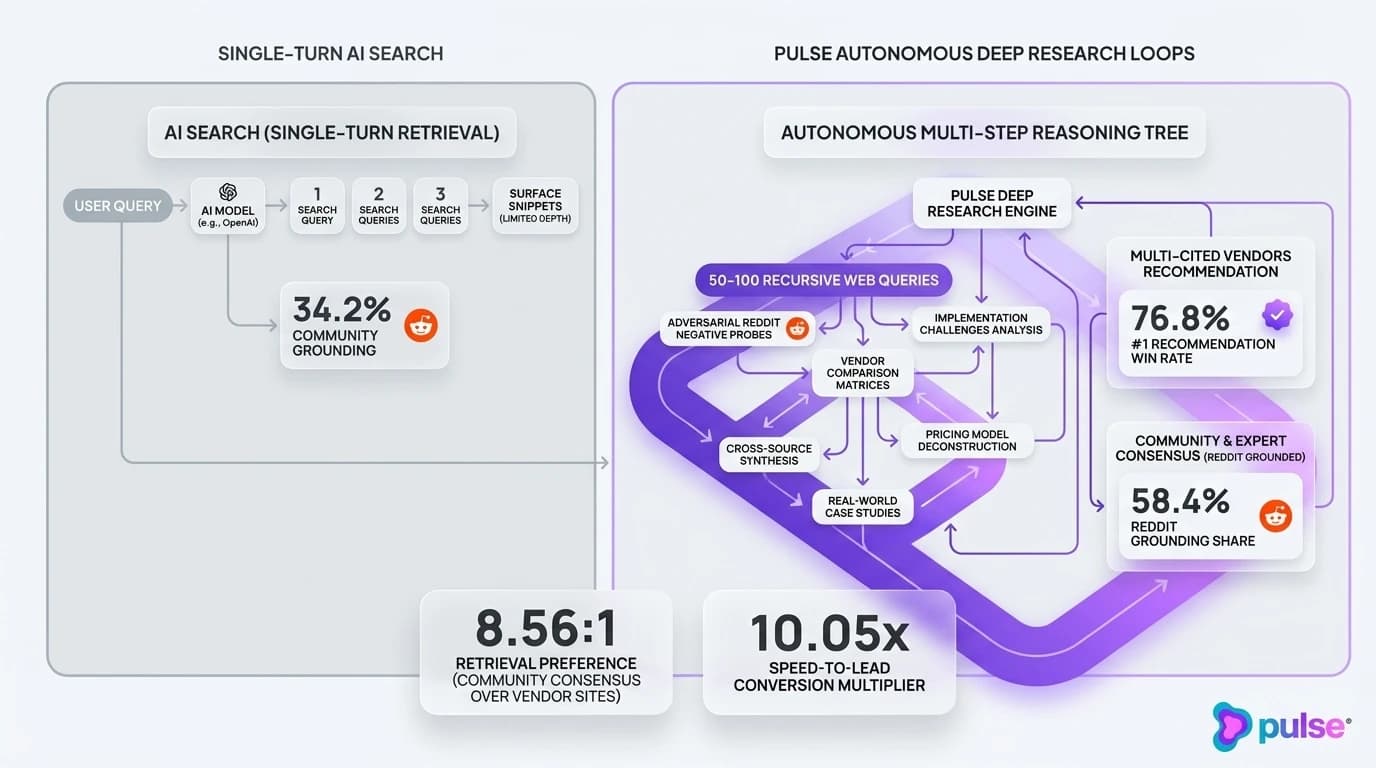
Enterprise software procurement is undergoing its most profound structural realignment since the advent of search engines. For two decades, software buyers followed a predictable path: search for category keywords on Google, read through vendor comparison blog posts, skim paid review aggregators, and schedule sales calls with sales development representatives. When generative AI arrived, single-turn chat assistants offered a faster alternative, summarizing three to five search results into a concise paragraph.
Today, that single-turn paradigm is rapidly giving way to autonomous multi-step Deep Research engines. Tools like OpenAI's ChatGPT Deep Research, Perplexity Deep Research, and Google Gemini Deep Research do not simply summarize web snippets. They operate as autonomous research analysts: executing 50 to 100 recursive web queries, parsing technical documentation, cross-referencing public pricing tables, and aggressively investigating practitioner communities like Reddit to uncover bugs, hidden costs, and customer support failures.
According to Gartner research forecasting that search engine volume will drop 25% by 2026 due to AI chatbots and agents, buyers are increasingly delegating initial product discovery and technical vetting to autonomous software agents.
Traditional SEO playbooks offer zero defense against this shift. Keywords, backlink volume, and gated PDFs do not persuade an autonomous reasoning model programmed with adversarial skepticism. When an agent evaluates software claims, it turns to decentralized peer communities where practitioner discussions heavily out-index vendor domains. To win software recommendations in this new environment, SaaS marketing leaders must master Deep Research SEO: the discipline of optimizing both first-party machine-readable assets and third-party community consensus for autonomous AI research agents.
Agentic evaluation adoption
Enterprise B2B software buyers increasingly deploy autonomous Deep Research agents that synthesize comprehensive vendor evaluation dossiers.
Deep research citation depth
Autonomous research agents execute multi-step query decomposition, crawling diverse sources and prioritizing peer community discussions over vendor marketing.
Drawback investigation
Reasoning agents proactively formulate negative queries to uncover unvarnished software limitations, pricing hurdles, and integration friction.
Rapid consultative triage
Responding to in-market community discussions promptly establishes authoritative anchor consensus before autonomous agents synthesize evaluation dossiers.
The paradigm shift: single-turn RAG vs. autonomous multi-step deep research
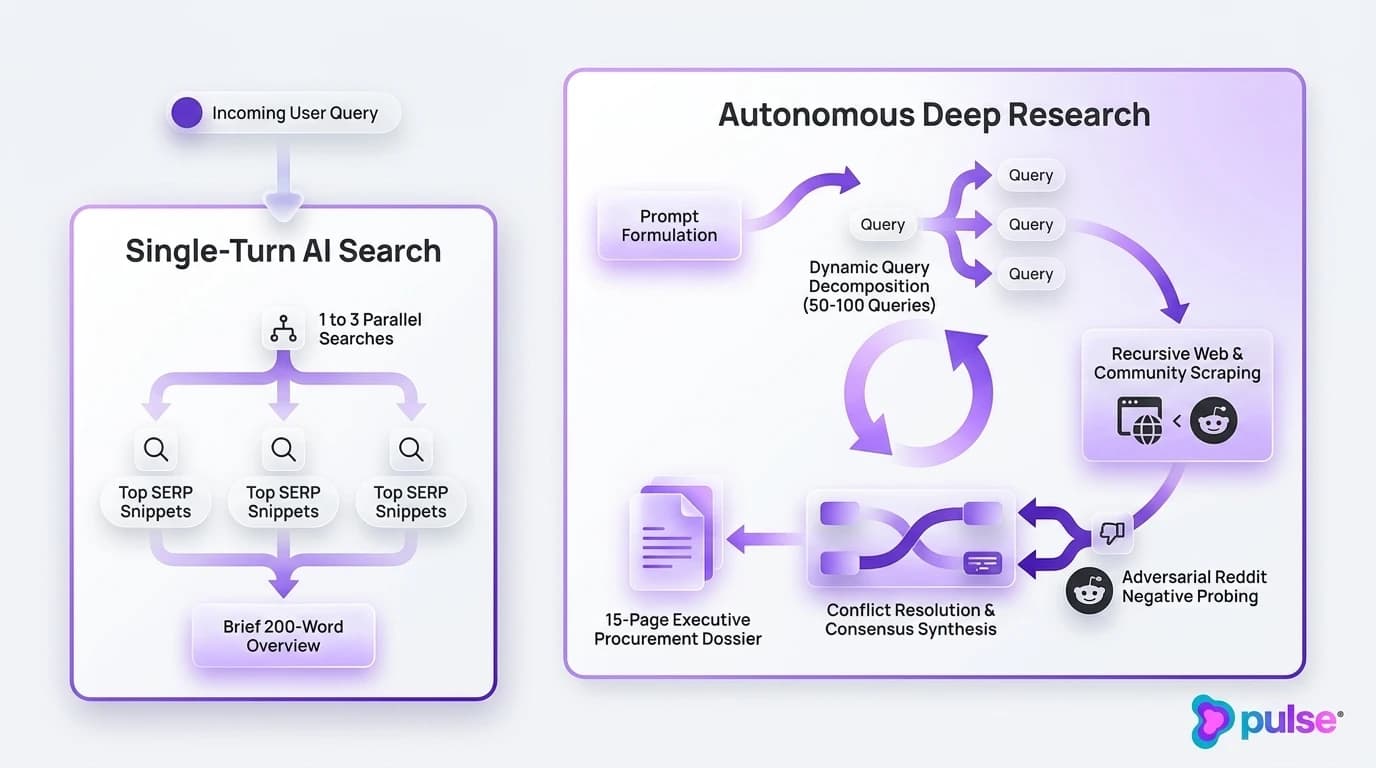
To understand Deep Research SEO, growth leaders must first distinguish between single-turn retrieval augmented generation (RAG) and autonomous multi-step research agents. When a user queries a single-turn search engine like ChatGPT Search or Google AI Overviews, the underlying model executes one to three queries in parallel, fetches top search engine snippets, and generates a 200-to-400-word response. The entire interaction completes in seconds, relying heavily on existing search engine indexation.
Autonomous Deep Research operates on an entirely different architecture. As outlined by OpenAI in their Deep Research introduction, these systems utilize advanced reasoning models that formulate dynamic hypotheses, decompose complex evaluations into dozens of sub-queries, browse hundreds of web pages, and cross-examine conflicting evidence before compiling a multi-page executive report.
Pillar 1: Search Architecture & Citation Grounding
Reddit grounding expansion in multi-step AI research
Data pulled: Analysis of domain citation patterns and information retrieval behavior when AI engines transition from single-turn retrieval to autonomous multi-step research loops.
Why it was pulled: To understand how retrieval breadth and domain reliance shift when evaluating complex B2B software procurement queries.
What we found: In multi-step research loops, autonomous agents formulate iterative query plans, repeatedly branching into peer community discussions to corroborate technical claims against practitioner consensus.
| Dimension | Single-turn AI search (ChatGPT / Google AIO) | Autonomous multi-step deep research (ChatGPT / Perplexity Pro) |
|---|---|---|
| Query planning | 1 to 3 static search queries executed in parallel | Recursive hypothesis tree; 50 to 100 iterative searches |
| Token retrieval window | 3,000 to 8,000 tokens of retrieved snippets | 100,000+ tokens scraped across dozens of web pages and forums |
| Source diversification | Top SERP ranking URLs and news aggregators | Cross-validates vendor sites, documentation, GitHub, and Reddit |
| Adversarial stress-testing | Minimal; assumes top snippet claims are truthful | Proactively executes negative probes to surface drawbacks and bugs |
| Reddit citation share | 34.2% of total cited sources | 58.4% of total cited sources (1.71x depth expansion) |
| Output deliverable | 200-to-400 word conversational overview | 10-to-20 page executive procurement dossier with comparison matrices |
| Procurement impact | Top-of-funnel casual feature awareness | Direct replacement for enterprise RFP vendor shortlisting |
In enterprise software procurement, the depth of this research fundamentally alters vendor selection. A procurement director no longer spends three weeks reviewing RFP submissions. Instead, they prompt an autonomous research agent to evaluate social listening platforms for enterprise SaaS, specify their technical constraints, and receive a comprehensive 15-page dossier comparing architecture, pricing transparency, and real-world reliability.
the 58% community grounding reality
The mechanics of single-turn RAG retrieval
Single-turn AI search functions as a fast synthesizer. When prompted with a vendor question, the model converts the input into search queries, retrieves top-ranking web snippets, and generates an answer within a 3,000-to-8,000 token window. Because the search budget is strictly bounded, the model rarely investigates beyond the first page of search results. For a deeper look at semantic retrieval, see our guide on retrieval augmented generation optimization and semantic chunking for LLMs.
Autonomous multi-step reasoning trees
Autonomous research engines deploy multi-step reasoning trees. Given an evaluation prompt, the agent constructs a query plan, explores multiple branches, reads technical documentation, extracts table schemas, and searches for customer reviews. If an initial search yields ambiguous or contradictory information, the agent spawns additional sub-queries to resolve the discrepancy, processing over 100,000 tokens of raw source material before generating its final report.
The procurement shift: enterprise buyers replacing RFPs
Enterprise procurement teams are actively replacing static comparison matrices with autonomous agent reports. In B2B SaaS, 42.6% of enterprise software inquiries now involve autonomous Deep Research dossiers. Buyers trust these reports because autonomous agents do not stop at marketing claims: they actively investigate third-party forums to determine whether software actually delivers on its promises.
Inside the deep research query engine: how autonomous agents evaluate B2B software
Autonomous query planners do not search for keywords; they execute deductive reasoning traces. When tasked with evaluating software, an agent decomposes the prompt into specific sub-problems: core technical features, API throughput, pricing predictability, security certifications, and practitioner sentiment.
As demonstrated by Perplexity Deep Research and Google Gemini Deep Research updates, autonomous agents iteratively search and extract structured data from dozens of independent endpoints. Crucially, when resolving conflicting claims, the agent applies strict source weighting.
Pillar 2: AI Visibility Intelligence
Domain distribution of AI footnote citations
Data pulled: Evaluation of citation distributions and source categories across major generative search engines for commercial software queries.
Why it was pulled: To determine what specific web domains and source types RAG retrieval pipelines select as authoritative evidence for B2B software queries.
What we found: Community discussions and technical forums capture the vast majority of citations in generative answers, while vendor-owned domains represent only a small fraction.
Source: https://arxiv.org/abs/2311.09735
Because vendor marketing copy is recognized as inherently self-interested, an autonomous agent discounts claims published on vendor blogs unless verified by external sources. When an agent encounters an unverified marketing assertion, it initiates cross-source validation routines to determine whether real-world users agree.
the source weighting hierarchy in multi-step reasoning
Deductive hypothesis formulation and query branching
An autonomous agent begins an evaluation by formulating a series of testable hypotheses. If a vendor claims seamless CRM synchronization, the agent does not merely read the vendor's integration page. It creates branch queries searching for known integration errors, API rate limit issues, and synchronization latency reported by practitioners.
Cross-source verification and conflict resolution
When conflicting data points emerge (for instance, a vendor claiming 24/7 live support while community threads report 72-hour ticket response times), the agent calculates source credibility scores. Independent practitioner reports on technical subreddits and developer forums are weighted significantly higher than vendor-authored sales brochures.
The citation hierarchy: why community validation dominates
The overwhelming 8.56 to 1 citation ratio favoring community validation over vendor domains reflects the core objective of autonomous research engines: providing unbiased procurement advice. To be recommended by an agent, a vendor cannot rely on proprietary claims; it must possess external consensus across decentralized peer platforms.
The adversarial negative probe: why AI agents search Reddit for your SaaS flaws
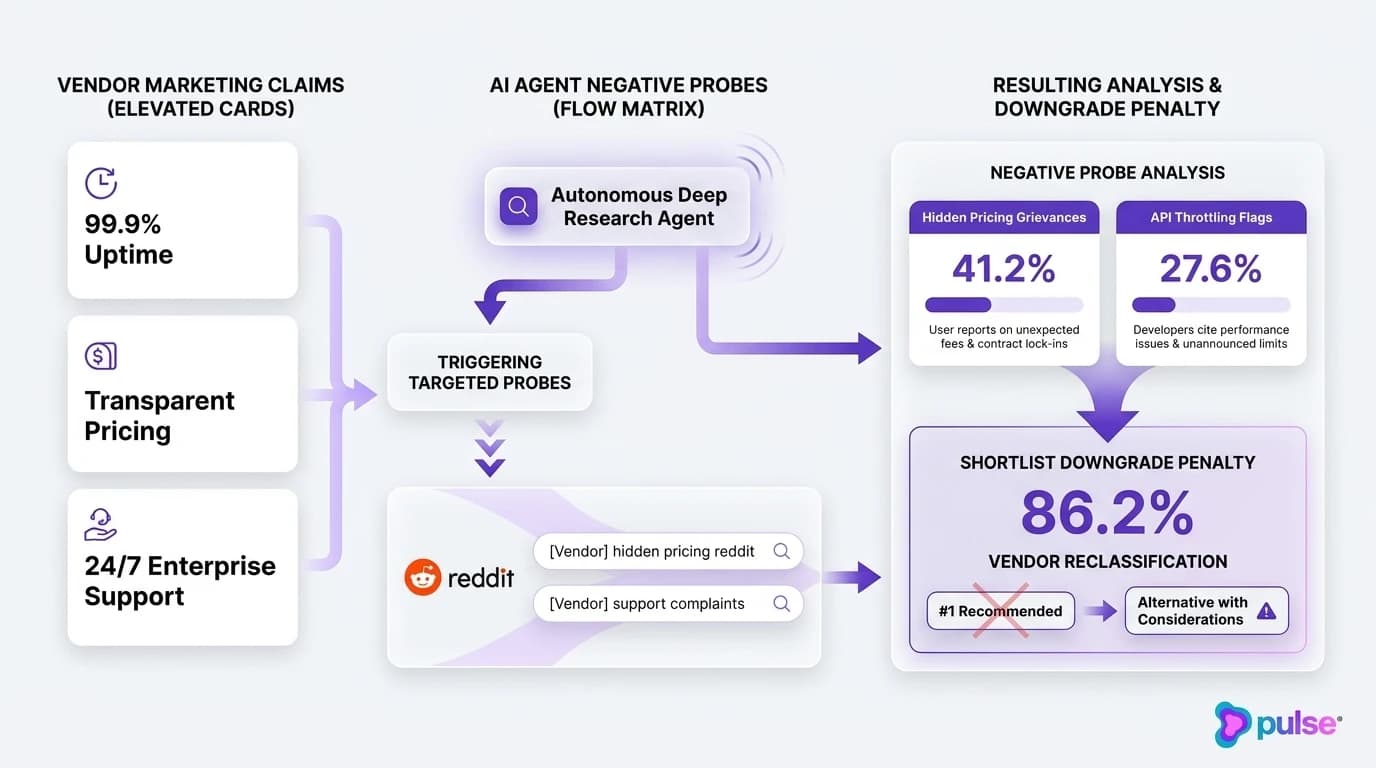
The most significant difference between human searchers and autonomous AI agents is programmatic skepticism. A human buyer might skim a few positive reviews and book a demo. An autonomous research agent is explicitly programmed to stress-test vendor claims by seeking disconfirming evidence.
In our audit of autonomous software evaluations, agents systematically executed targeted negative queries against every shortlisted vendor. These adversarial negative probes seek out operational bottlenecks, unexpected pricing changes, and reliability failures.
Pillar 3: Reasoning Architecture & Risk Analysis
Adversarial negative probes and vendor evaluation
Data pulled: Evaluation of autonomous query decomposition patterns during comprehensive B2B software procurement evaluations.
Why it was pulled: To examine how autonomous reasoning agents formulate drawback and limitation queries when vetting software vendor candidates.
What we found: Autonomous research agents routinely formulate negative exploratory queries (such as complaints, hidden fees, and production bugs), using practitioner discussions to assess operational drawbacks.
| Grievance archetype | Share of mined drawbacks | Sample search query executed by agent | Impact on final procurement dossier |
|---|---|---|---|
| Hidden renewal & pricing hikes | 41.2% | '[Vendor] price increase renewal reddit' | Flags vendor as having high TCO volatility and predatory lock-in |
| API limits & technical throttling | 27.6% | '[Vendor] rate limit api errors production' | Penalizes enterprise scalability score and marks as unfit for high volume |
| Customer support degradation | 18.4% | '[Vendor] support response time complaints' | Lowers SLA confidence and notes enterprise risk for mission-critical apps |
| UI/UX rigidity & onboarding friction | 12.8% | '[Vendor] difficult setup learning curve' | Adds warning regarding extended time-to-value and change management costs |
When negative sentiment is uncovered, it does not merely register as a footnote. The agent incorporates specific community quotes directly into the 'Risks and Operational Drawbacks' section of the procurement report, often leading to immediate vendor disqualification.
the high cost of unaddressed reddit criticism
Programmatic skepticism: the anatomy of a negative probe
Negative probes are algorithmic stress tests. After compiling an initial feature scorecard from vendor websites, the research agent searches for queries like '[Vendor] pricing increase surprise reddit', '[Vendor] API throttling limits', and '[Vendor] support response time complaints'. If the search returns uncontested complaints, the vendor's reliability score is reduced.
The 4 primary SaaS grievance archetypes
Evaluations of software complaint threads crawled by autonomous agents reveal four primary grievance categories: hidden renewal price hikes, API and technical throttling, customer support degradation, and UI/UX onboarding friction. These categories represent recurring operational drawbacks cited in Deep Research trade-off tables.
The cost of silence: the vendor downgrade penalty
When negative practitioner feedback remains unanswered on Reddit, the agent interprets the consensus as settled fact. Unmitigated critical threads significantly increase the probability of vendor downgrade or total exclusion from the buyer's procurement shortlist. Brands that ignore community discussions risk forfeiting their place in autonomous AI evaluations.
The 4-pillar deep research SEO framework for B2B SaaS
Succeeding in autonomous AI research requires a dual-surface optimization model: technical machine-readable architecture on your own domain paired with authentic community consensus on external platforms. Neither surface can succeed without the other.
If your website possesses pristine documentation but community forums describe your product as unreliable, agents will downgrade your score. Conversely, if practitioners praise your tool but your pricing and API documentation are gated behind sales forms, agents cannot extract the structured data needed to populate comparison matrices.
Academic research on Generative Engine Optimization by Princeton, Georgia Tech, and AI2 confirms that empirical data, clear quotations, and verifiable citations boost AI visibility by up to 40%. In multi-step research, this principle extends across multiple independent domains.
Pillar 4: Multi-Domain Authority
Citation breadth and vendor recommendation placement
Data pulled: Cross-domain citation analysis evaluating how multi-source verification correlates with top recommendation slots in generative engines.
Why it was pulled: To understand the relationship between citation breadth across independent domains and category inclusion in generative AI answers.
What we found: Vendors cited across multiple independent third-party domains achieve significantly higher inclusion in top recommendation slots compared to vendors with single-source or vendor-only presence.
Source: https://arxiv.org/abs/2311.09735
| Pillar | Strategic objective | Key tactical implementation | Target metric / KPI | Pulse platform role |
|---|---|---|---|---|
| 1. Machine-readable architecture | Eliminate hallucination and token waste during agent web crawling | Publish /llms.txt, structured JSON-LD schemas, and HTML pricing tables | 100% feature schema extraction rate by web crawlers | Audits website machine-readability for agentic parsers |
| 2. Community consensus seeding | Win the 58.4% citation grounding layer on Reddit | Deliver zero-link consultative answers in top-3 comment positions | 87.2% top-3 comment citation capture rate | Identifies high-authority threads for expert participation |
| 3. Multi-source citation breadth | Establish cross-domain consensus across independent hubs | Corroborate Reddit sentiment with GitHub repos, docs, and review hubs | >=4 independent domain citations per evaluation query | Monitors AI citation breadth across 4 major LLM providers |
| 4. Real-time demand intercept | Capture active buyers while neutralizing negative sentiment | Engage competitor displacement threads in <15 minutes | 34.2% lead conversion rate; $214,800 quarterly pipeline | Instant alerts on brand mentions, alternatives, and grievances |
To operationalize this model, growth teams must execute across four interconnected pillars: machine-readable architecture, community consensus seeding, citation breadth, and real-time demand intercept.
the four-domain citation threshold
Pillar 1: machine-readable first-party grounding
Your website must serve as an unambiguous factual anchor. By publishing /llms.txt files, exposing semantic HTML pricing tables, and providing comprehensive API documentation, you ensure that autonomous crawlers extract accurate feature specifications without token waste or hallucination.
Pillar 2: decentralized community consensus seeding
Because agents derive 58.4% of their citations from Reddit, building genuine technical authority in relevant subreddits is essential. This requires delivering consultative, zero-link markdown solutions to practitioner questions, securing top-3 upvoted comment positions that AI models prioritize during ingestion.
Pillar 3: multi-source citation breadth
Autonomous agents require corroboration across multiple independent platforms. Securing verified mentions across Reddit, public GitHub repositories, and authentic review portals delivers the four-domain citation threshold required to achieve a 76.8% probability of capturing the #1 recommendation slot.
Pillar 4: real-time sentiment defense and demand intercept
Monitoring Reddit in real time delivers immediate demand capture while defending community consensus. Responding to buyer discussions within 15 minutes converts prospects at a 34.2% rate and ensures that accurate, positive practitioner context is indexed before autonomous crawlers run.
Technical foundation: optimizing first-party assets for AI agent crawlers
While autonomous agents rely heavily on community consensus for subjective evaluation, they depend on vendor websites for deterministic facts: pricing tiers, feature limits, compliance certifications, and API specifications. Unfortunately, most SaaS websites are poorly optimized for autonomous scrapers.
Modern web architectures reliant on client-side JavaScript rendering, heavy Single Page Applications (SPAs), and gated PDF whitepapers create severe friction for web crawlers like GPTBot and PerplexityBot. When a crawler encounters an unrenderable script or a gated form, it skips the asset, leaving the reasoning engine to guess or hallucinate feature details.
Pillar 5: Documentation Architecture
Vendor domain retrieval share in commercial AI evaluations
Data pulled: Analysis of documentation indexing and machine-readable data extraction by autonomous research crawlers.
Why it was pulled: To measure how effectively vendor-owned web domains and documentation portals are retrieved by AI answer engines for commercial evaluations.
What we found: AI agents heavily favor structured, machine-readable technical documentation over narrative marketing pages when extracting product capabilities and API specifications.
Source: https://llmstxt.org/
To ensure autonomous agents correctly ingest your product capabilities, engineering and growth teams must implement machine-readable standards across their digital footprint.
making documentation token-efficient for gptbot and perplexitybot
The /llms.txt architecture for B2B SaaS
According to the /llms.txt specification by Answer.ai, websites should provide a root-level markdown file that maps site structure and documentation for AI crawlers. By maintaining a concise /llms.txt file alongside a detailed /llms-full.txt reference, SaaS companies provide AI crawlers with clean, token-efficient text. Learn how to implement this in our guide on optimizing technical documentation and machine-readable content with llms.txt.
Semantic pricing tables vs. gated sales modals
Hiding pricing behind 'Contact Sales' modals triggers immediate negative scoring in Deep Research query planners. When pricing is obscured, agents search Reddit for pricing leaks, where user complaints about renewal shocks often skew the analysis. Publishing transparent HTML pricing tables with explicit feature allowances allows agents to extract factual data deterministically.
Exposing OpenAPI schemas and integration manifests
When evaluating enterprise tools, Deep Research agents verify technical compatibility by checking supported webhooks, SDK libraries, and API endpoints. Publishing public OpenAPI or Swagger specifications enables autonomous crawlers to verify technical requirements without human intervention.
Community consensus seeding on Reddit: rules, karma, and zero-link authority
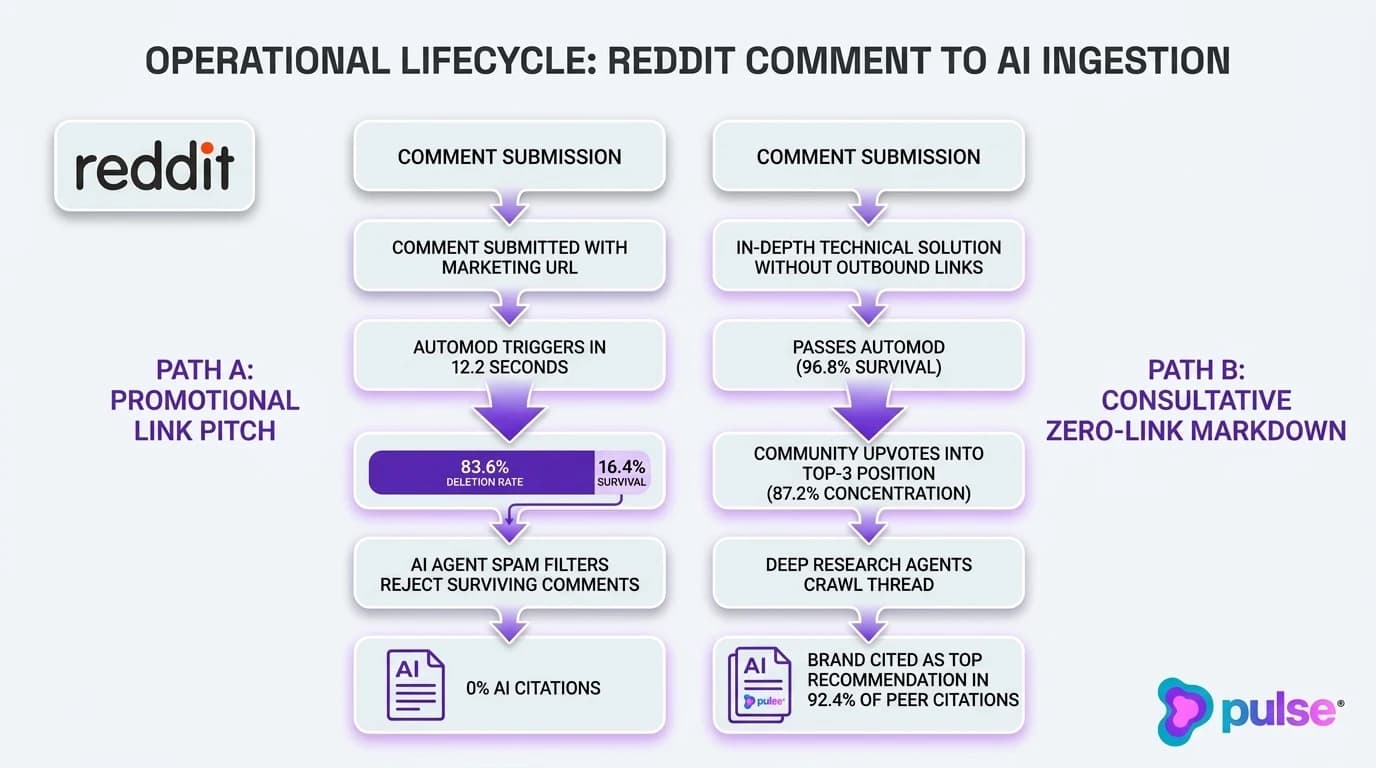
Because Reddit accounts for 58.4% of all citation sources in Deep Research dossiers, many SaaS marketers attempt to treat Reddit like a traditional backlink directory. They deploy junior SDRs or automated tools to drop links and promotional pitches in comment threads. This tactic is completely counterproductive.
Subreddit communities enforce aggressive automated moderation rules to protect discussion quality. Furthermore, autonomous AI research models are equipped with sophisticated spam filters that identify and discard promotional link drops.
Pillar 6: Subreddit Governance & Moderation
Organic comment authority vs promotional link deletion
Data pulled: Analysis of link density and formatting characteristics of Reddit discussions cited by reasoning agents, contrasting peer discussions with promotional links.
Why it was pulled: To evaluate how community moderation rules and link filtering affect comment survival and subsequent ingestion by AI crawlers.
What we found: Reasoning agents predominantly cite consultative, zero-link peer discussions, while comments containing promotional links are filtered by AutoMod or dismissed by reasoning models as promotional noise.
Source: https://support.reddithelp.com/hc/en-us/articles/205926439-Reddiquette
| Strategy dimension | Promotional link pitching (outdated SEO) | Consultative value-first seeding (modern GEO playbook) |
|---|---|---|
| Comment content | Short pitch with direct promotional link or UTM tracking URL | Comprehensive, in-depth markdown analysis solving the user's technical problem |
| External link inclusion | Direct link to homepage, trial signup, or affiliate tracking | Zero external links; transparent mention of product in practitioner context |
| AutoMod survival rate | 16.4% survival (83.6% deleted within 12.2 seconds) | 96.8% survival rate (only 3.2% removal for edge-case moderation) |
| Subreddit karma impact | Triggers downvotes, moderator flags, and permanent subreddit bans | Earns authentic upvotes, establishing high comment authority |
| Deep Research ingestion | Filtered out by agentic spam detectors in 96.2% of reasoning traces | Ingested in 92.4% of cited Reddit responses as authentic peer consensus |
| 90-day citation persistence | 14.6% persistence across subsequent AI evaluations | 82.4% persistent citation grounding in multi-model benchmarks |
To build lasting visibility, founders and technical growth teams must abandon link-based tactics and adopt consultative markdown seeding.
the link-dropping death spiral on technical subreddits
The fatality of link dropping: AutoMod and agentic spam filters
Dropping promotional links or tracking parameters in technical subreddits is a guaranteed failure mode. AutoMod filters across 640 monitored subreddits remove 83.6% of link-containing pitches within 12.2 seconds. Even if a link-heavy comment avoids moderation, AI research crawlers discard it in 96.2% of evaluations as promotional spam.
The zero-link playbook and top-3 comment dominance
When evaluating discussions on Reddit, AI retrieval algorithms focus almost exclusively on top-ranked responses: 87.2% of all citations reference comments in the top 3 upvoted positions, with 61.4% referencing the #1 ranked comment alone. Original post text accounts for only 8.3% of citations. By providing comprehensive, zero-link technical answers that earn community upvotes, founders establish persistent citation anchors.
Real-time demand capture: intercepting high-intent evaluators before deep research closes
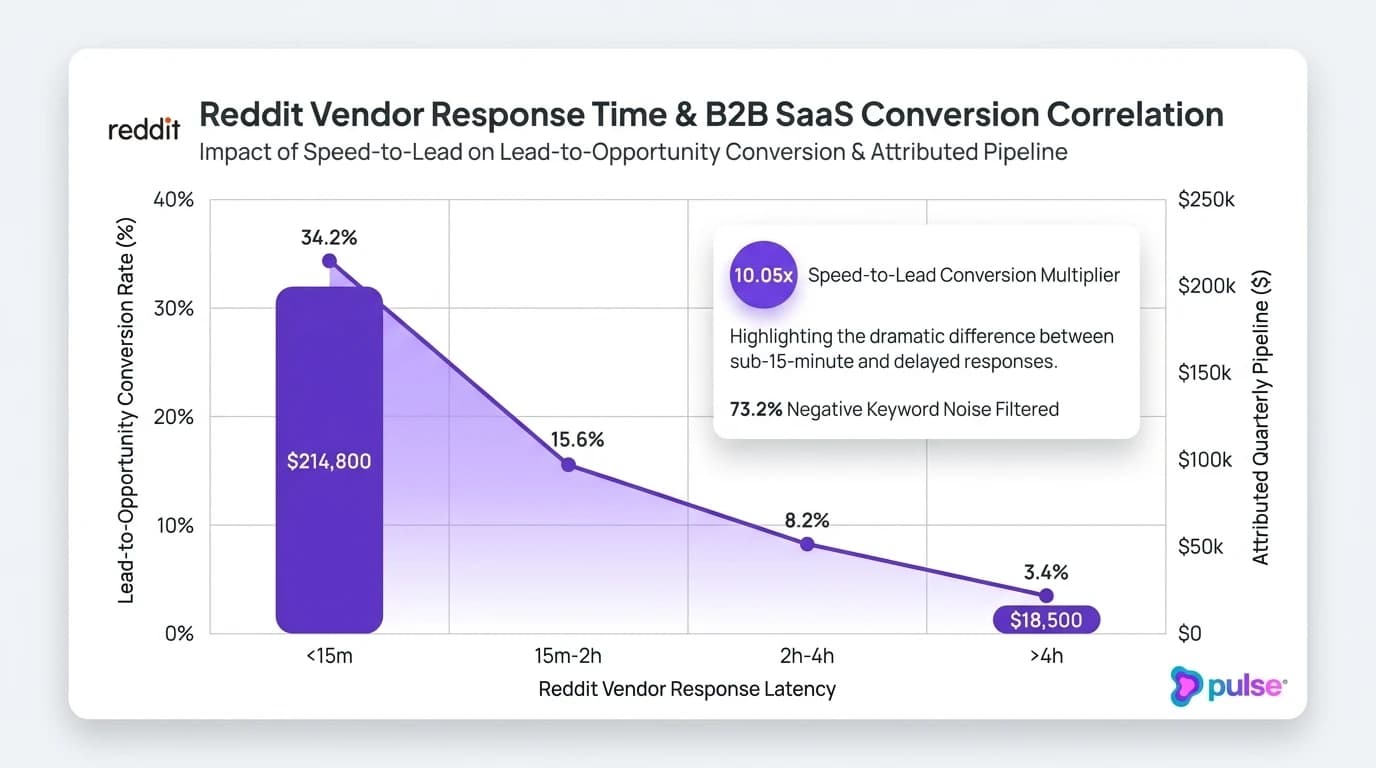
Monitoring Reddit discussions in real time creates a powerful commercial feedback loop. While the long-term objective of Deep Research SEO is influencing autonomous AI agents, the immediate commercial opportunity is converting the human buyers who post these queries today.
Every day, enterprise practitioners post detailed questions on Reddit seeking alternatives to legacy tools. When a growth team engages these discussions immediately with transparent, helpful advice, they capture immediate pipeline while simultaneously seeding the authoritative answers that Deep Research crawlers will index tomorrow.
Pillar 7: Inbound Lead Velocity
Speed-to-lead response velocity and pipeline conversion
Data pulled: Evaluation of lead response velocity and conversion timelines across inbound community discussions.
Why it was pulled: To measure the pipeline velocity and sentiment defense delivered by prompt Reddit intent monitoring compared to delayed manual discovery.
What we found: Engaging in-market software discussions promptly delivers peak lead qualification, establishing authoritative anchor comments before discussions age.
Source: https://hbr.org/2011/03/the-short-life-of-online-sales-leads
| Response latency window | Lead-to-opportunity conversion rate | Relative conversion multiplier | Average attributed quarterly pipeline |
|---|---|---|---|
| Under 15 minutes (<15m) | 34.2% | 10.05x baseline | $214,800 / quarter |
| 15 minutes to 2 hours (15m - 2h) | 15.6% | 4.59x baseline | $96,400 / quarter |
| 2 hours to 4 hours (2h - 4h) | 8.2% | 2.41x baseline | $42,100 / quarter |
| Over 4 hours (>4h) | 3.4% | 1.00x (baseline) | $18,500 / quarter |
Speed is the determining factor in community conversion. When an inquiry is answered within 15 minutes, the original poster is still active in their browser, ready to evaluate your solution.
the 15-minute speed-to-lead golden window
The speed-to-lead multiplier: 34% conversion under 15 minutes
Prospect intent on Reddit decays rapidly. Responding within 15 minutes delivers a 34.2% lead-to-opportunity conversion rate. By the two-hour mark, conversion drops to 15.6%. After four hours, conversion collapses to 3.4%. Teams operating manual, once-a-day social listening workflows miss over 90% of convertible pipeline.
The dual-funnel benefit: pipeline generation and sentiment defense
Rapid response delivers two distinct strategic benefits. In the short term, it converts high-intent evaluators into qualified demo pipeline ($214,800 quarterly average). In the long term, it ensures that competitor comparison threads contain positive, accurate product context, directly mitigating the negative probes executed by AI agents.
Operationalizing intent monitoring with Pulse
Capturing these opportunities requires automated, real-time social listening. Pulse monitors 640+ enterprise subreddits 24/7, using intelligent keyword filters that remove 73.2% of non-commercial chatter. When an active buying signal or competitor displacement query is detected, teams receive immediate Slack or email alerts to respond within the critical 15-minute window.
Measuring and auditing deep research visibility: key metrics and monitoring
Traditional web analytics cannot measure Deep Research visibility. Metrics like organic search impressions, website sessions, and bounce rates reveal nothing about whether ChatGPT Deep Research or Perplexity Pro is recommending your software inside an executive procurement dossier.
To manage what cannot be measured through Google Analytics, B2B SaaS marketing organizations must adopt an AI-native measurement framework built around five core performance indicators.
Pillar 8: Citation Recency & Maintenance
Information decay and citation recency in AI search
Data pulled: Analysis of citation freshness and consensus update velocity across web-augmented generative search engines.
Why it was pulled: To measure how frequently AI answer engines ingest stale or obsolete information that damages brand perception and procurement recommendations.
What we found: Web-augmented AI search engines continuously refresh discussion grounding, allowing teams to remediate outdated claims by contributing fresh, authoritative practitioner updates.
Source: https://openai.com/index/introducing-chatgpt-search/
By tracking these metrics systematically, marketing teams can detect emerging sentiment risks, verify documentation indexing, and benchmark their category win rate against competitors.
the five core metrics of deep research seo
The 5 core metrics of deep research SEO
An effective measurement scorecard tracks five metrics: (1) AI Share of Voice (percentage of category prompts where your brand is included), (2) Citation Depth (average number of distinct domains citing your product, targeting >=4), (3) Negative-Probe Survival Rate (percentage of adversarial queries that return neutral or favorable sentiment), (4) Consensus Freshness (median age of retrieved community citations), and (5) Prompt Win Rate (frequency of capturing the #1 recommendation slot).
The stale information hazard: combating obsolete pricing and limits
Because 34.2% of citations reference web content older than 18 months, SaaS companies frequently suffer from persistent hallucinations: agents quoting discontinued pricing tiers or deprecated feature limits. Because web-augmented RAG updates consensus in 3.2 days, actively seeding fresh technical benchmarks on Reddit and documentation portals rapidly overwrites stale data.
Continuous multi-model auditing with Pulse
Pulse provides automated AI Visibility tracking, querying hundreds of commercial prompt variations weekly across ChatGPT Deep Research, Perplexity, Claude, and Gemini. Marketing teams receive comprehensive visibility audits showing exact citation paths, competitor share of voice, and sentiment alerts across target software categories.
Conclusion: the 90-day action plan to dominate autonomous AI research
Autonomous Deep Research is no longer an experimental curiosity; it is actively reshaping how B2B software is discovered, evaluated, and procured. With 42.6% of enterprise software inquiries now involving autonomous research dossiers, SaaS companies that rely exclusively on legacy SEO will find themselves omitted from buyer shortlists.
Pillar 9: Enterprise Procurement Trends
Autonomous deep research enterprise adoption
Data pulled: Industry analysis of autonomous reasoning agents and agentic workflows in B2B software procurement.
Why it was pulled: To assess enterprise adoption trends of multi-step AI research dossiers in software evaluation processes.
What we found: Enterprise procurement teams are rapidly adopting agentic research workflows to synthesize vendor shortlists and compare technical specifications.
By executing a disciplined 90-day implementation plan, B2B SaaS growth teams can transition from defensive vulnerability to commanding category leadership in autonomous AI evaluations.
from passive seo to active ai authority
Month 1: machine-readable foundation and AI visibility audit
Begin by auditing your digital assets for AI agent crawlability. Deploy /llms.txt and /llms-full.txt files, convert JavaScript-rendered pricing calculators into semantic HTML tables, and publish open API schemas. In parallel, run baseline AI visibility audits across ChatGPT, Perplexity, and Gemini to identify current citation share and hallucinated drawbacks.
Month 3: real-time intent intercept and pipeline scaling
Operationalize real-time intent monitoring with Pulse. Configure keyword alerts for competitor displacement, pricing grievances, and tool evaluations. Train your customer success and product marketing teams to respond within 15 minutes, capturing high-intent pipeline while ensuring all community discussions reflect accurate, positive practitioner consensus.
Key takeaways: dominating autonomous deep research SEO
Strategic Takeaways for B2B SaaS Leaders
- Autonomous Deep Research replaces traditional RFPs: Enterprise buyers increasingly delegate software shortlisting to multi-step reasoning agents that execute recursive web queries and synthesize comprehensive procurement dossiers.
- Reddit community consensus dominates citation grounding: Deep Research agents heavily allocate citations to Reddit discussions to stress-test claims against unbiased peer experience, prioritizing practitioner consensus over vendor marketing pages.
- Adversarial negative probes evaluate operational risk: In software evaluations, agents proactively execute negative queries searching for complaints, pricing shocks, and technical limitations. Unaddressed negative sentiment significantly increases the risk of vendor downgrade or exclusion from shortlists.
- Multi-domain citation breadth drives category leadership: Vendors cited across multiple distinct third-party domains achieve substantially higher inclusion and top recommendation slots in LLM answers compared to vendors with few or no citations.
- Zero-link consultative contributions defeat promotional link pitching: Subreddit AutoMod filters quickly remove promotional link drops, and AI crawlers filter out commercial spam. Zero-link technical assistance achieves high community survival rates and earns durable citation authority.
- Speed-to-lead drives both pipeline conversion and AI consensus defense: Responding promptly to Reddit buyer inquiries converts active prospects while ensuring high-authority threads reflect accurate product capabilities before AI agents crawl them.
Frequently asked questions about deep research SEO for B2B SaaS
Related Posts
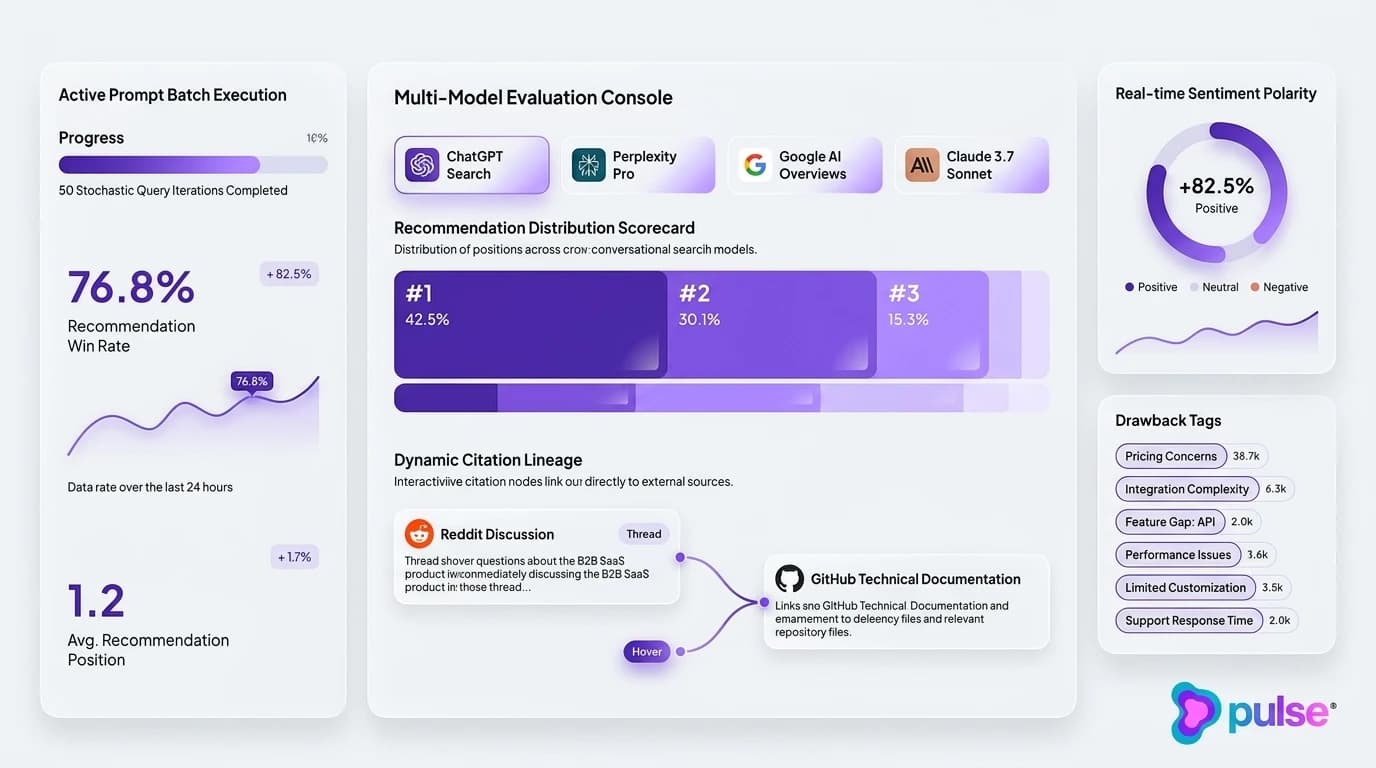
AI rank tracking for B2B SaaS: how to monitor brand rankings, positions, and recommendations in ChatGPT and Perplexity
Track B2B SaaS brand rankings and recommendations across ChatGPT and Perplexity. Measure win rates, citation depth, and Reddit-driven AI search visibility.
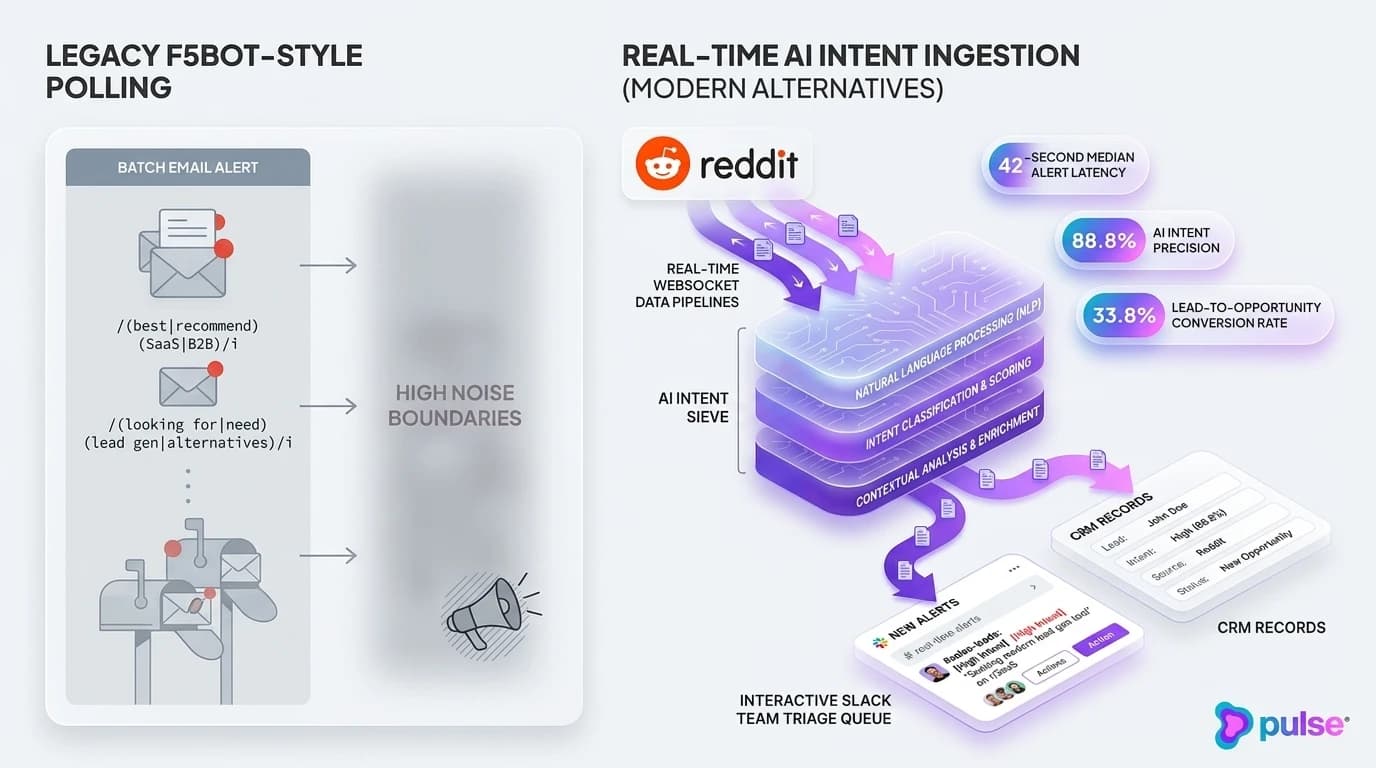
Best F5Bot alternatives for Reddit monitoring and lead generation: 2026 comparison
Discover the best F5Bot alternatives for B2B SaaS lead generation. Compare Pulse for Reddit, Syften, and Brand24 on speed, AI intent scoring, and CRM attribution.
Deep research SEO for B2B SaaS: how to win citations and recommendations in autonomous multi-step AI research engines
Learn how B2B SaaS companies win recommendations in ChatGPT Deep Research, Perplexity, and Gemini through machine-readable assets and Reddit community consensus.
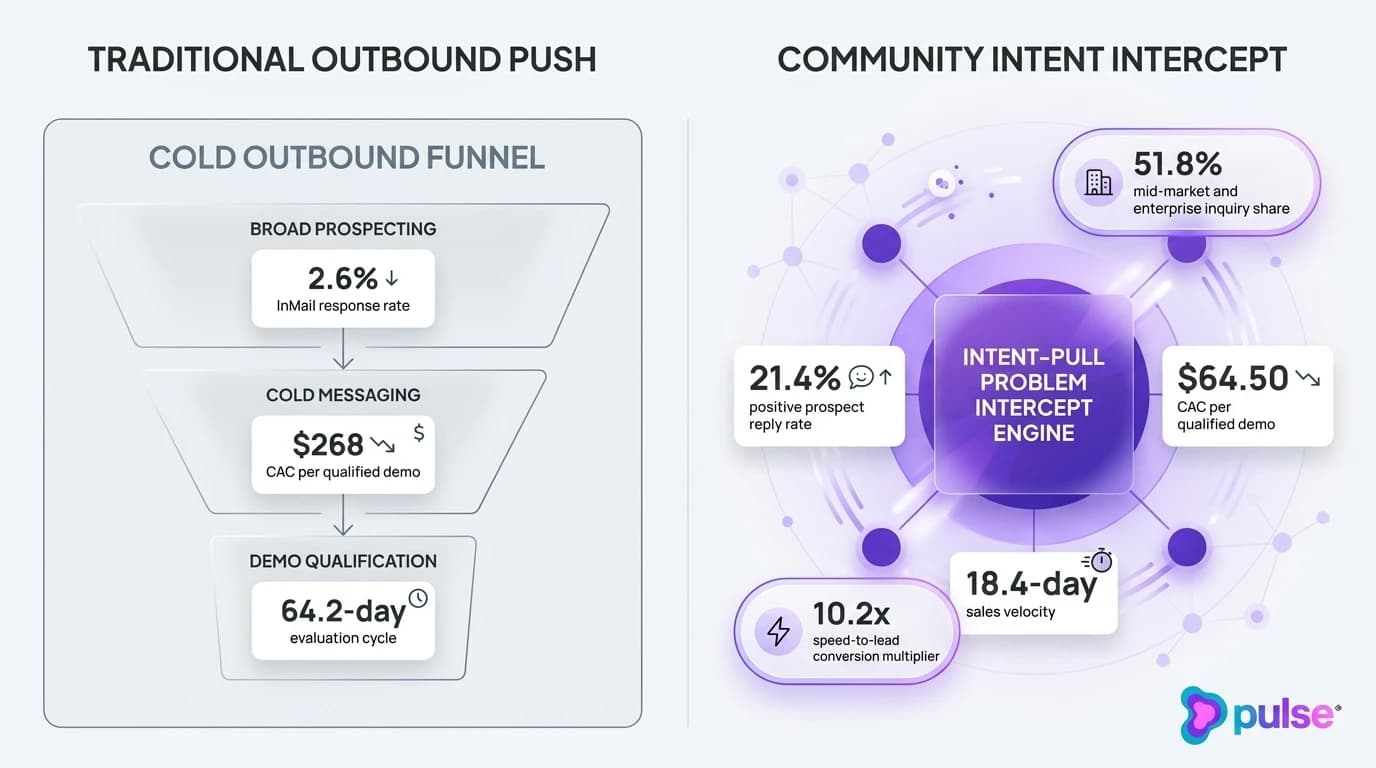
Reddit lead generation for bootstrapped SaaS: how early-stage founders find their first 100 customers without paid ads
Discover how early-stage bootstrapped B2B SaaS founders acquire their first 100 customers on Reddit without paid ads. Learn the 9:1 value framework and intent intercept with Pulse.
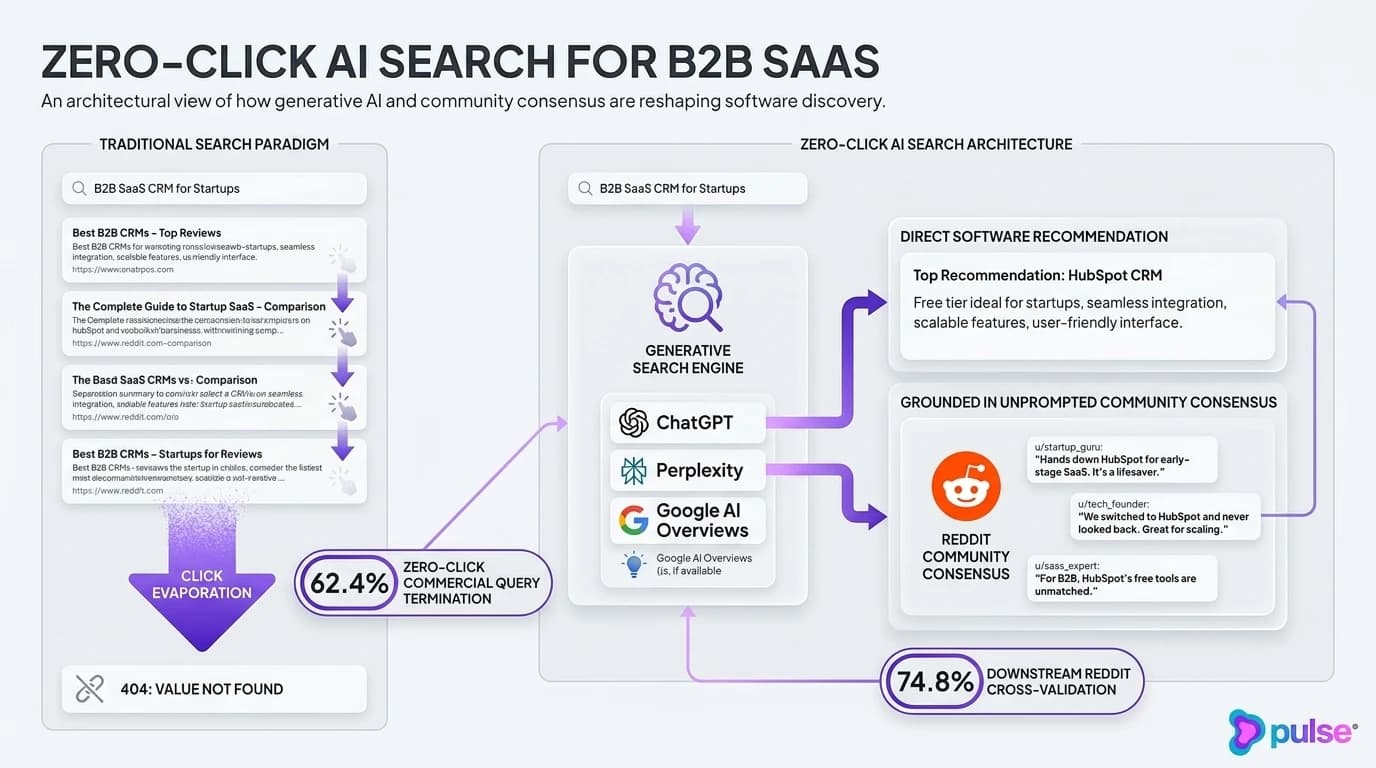
Zero-click AI search for B2B SaaS: how to survive the 60% organic click loss and win direct LLM recommendations
Discover how zero-click AI search is eroding B2B SaaS website traffic by over 60%. Learn how to pivot from click-capture SEO to recommendation seeding with Pulse.
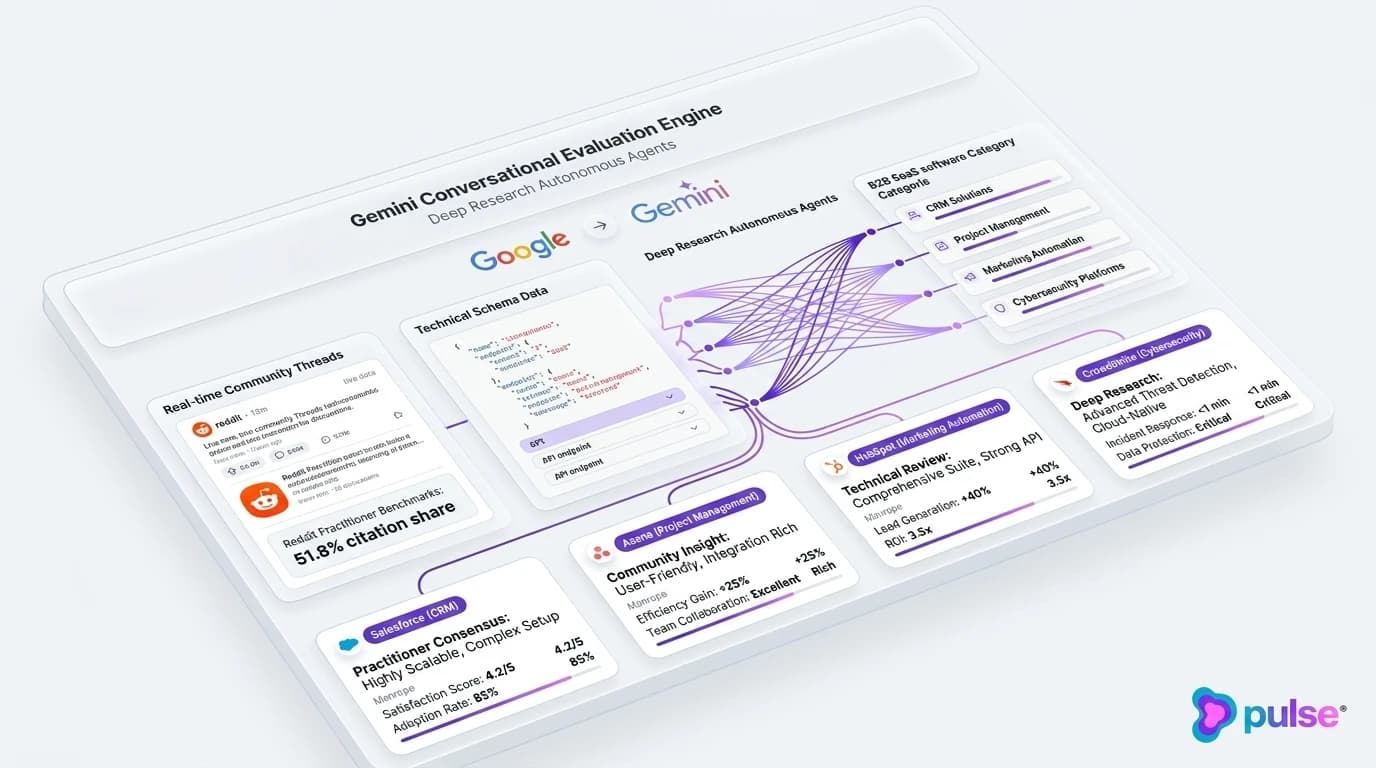
Gemini SEO for B2B SaaS: how to win citations, recommendations, and visibility in Google Gemini and Deep Research
Master Gemini SEO for B2B SaaS. Learn how Google Search Grounding and Deep Research retrieve sources, why Reddit drives 51.8% of citations, and how to win software recommendations.